
If you’re preparing to seek marketing authorization in the EU or UK, the pediatric investigation plan (PIP) process is one of the first places things can go wrong — and one of the last places most teams expect it.
The assumption is that pediatric obligations are a compliance box to check after the adult program is well underway. In practice, they shape your development timeline from much earlier than most sponsors realize.
A PIP is not a downstream formality; it’s a regulatory commitment that the European Medicines Agency (EMA) or Medicines and Healthcare products Regulatory Agency (MHRA) will hold you to throughout development. Get it wrong early, and you’re managing the consequences years later — through deferred milestones, costly amendments, or failed negotiations that put your entire EU/UK launch at risk.
This blog covers six recurring pitfalls in PIP submissions, why they catch US sponsors off guard, and how you can avoid them before they become expensive problems.
What US sponsors need to understand first
The US equivalent of the pediatric investigation plan is the pediatric study plan (PSP), managed under the Pediatric Research Equity Act (PREA) through the Food and Drug Administration (FDA). Both frameworks share the same underlying intent — ensuring medicines are appropriately studied in children — but their structure, timing, and enforcement differ in ways that matter operationally.
For example, one important distinction to note is that the PREA does not apply to orphan-designated drugs in the US, meaning a PSP is not always required. In the EU and UK, there is no equivalent exemption — a PIP is required for all medicinal products, including orphan drugs, before a marketing authorization application (MAA) can be submitted.
Under the FDA, the PSP is typically submitted after the end-of-phase-2 meeting and focuses on study commitments. The EMA’s PIP process starts earlier, often during early-phase clinical development, and requires a binding agreement before an MAA can be submitted. The MHRA, post-Brexit, runs a separate PIP process with its own timelines and procedural requirements, though it broadly mirrors the EMA approach.
The regulatory submission itself is also more technically demanding than a PSP — with stricter requirements around endpoint justification, age-range coverage, and formulation planning. Preparing that regulatory submission without prior EMA or MHRA experience is one of the most common reasons US companies encounter avoidable delays.
Here are six of the other common pitfalls:
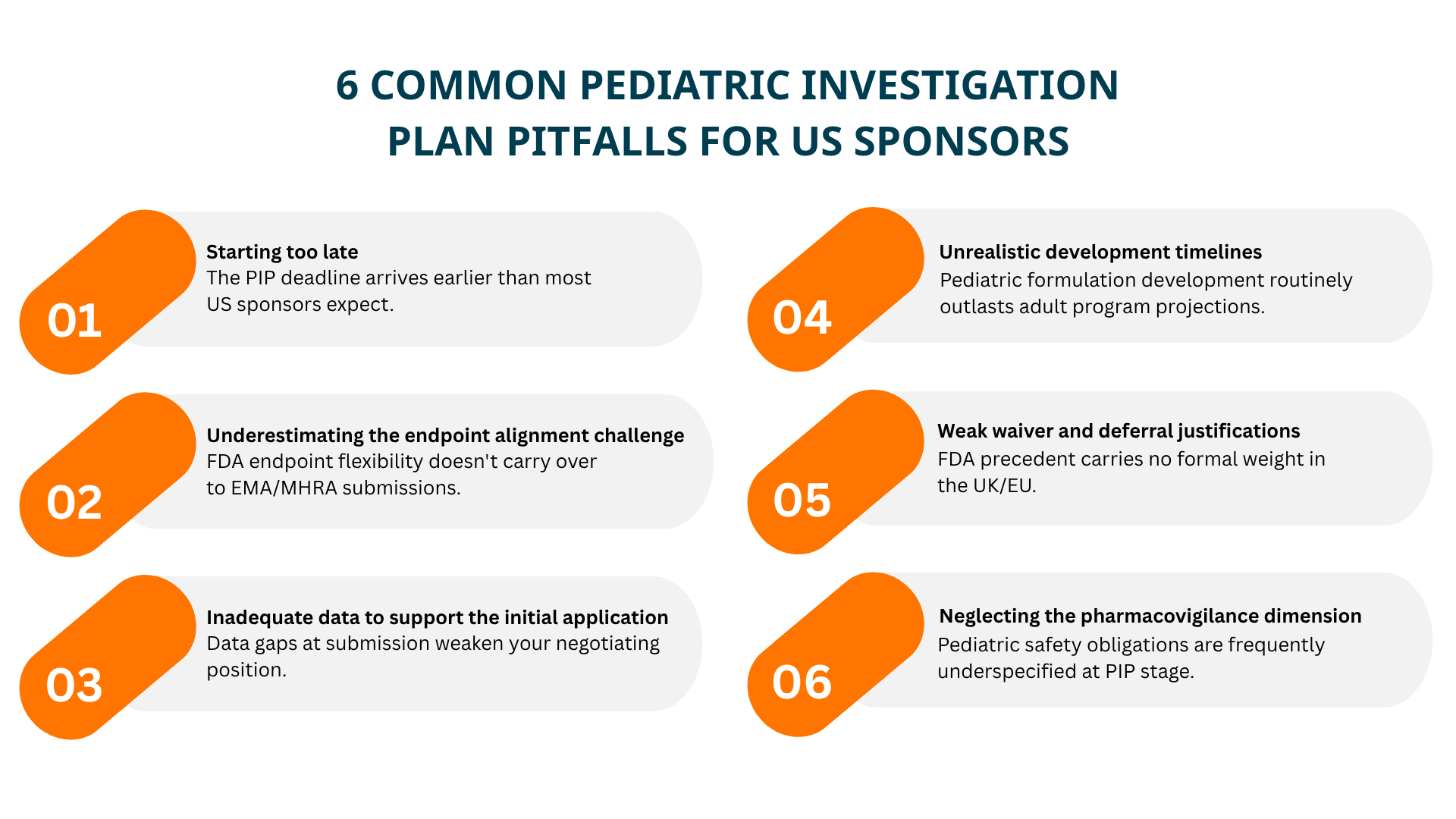
1. Starting too late
The pediatric investigation plan application needs to be submitted to the EMA’s Pediatric Committee (PDCO) no later than the completion of adult pharmacokinetic studies. That’s early. For many US companies in active early-phase clinical development, it falls during a period when the pediatric strategy feels like a future problem.
Waiting until the adult program is further along means compressing the PIP review timeline against other regulatory activities, increasing the risk of delayed marketing authorization if the PIP is not agreed upon before the MAA is filed.
The PDCO review process itself takes several months, and amendment requests — which are common — extend it further. You need to start the PIP strategy conversation at the same time as adult trial design to keep options open.
2. Underestimating the endpoint alignment challenge
One of the most frequent sources of PDCO questions and negotiation delays is the mismatch between adult endpoints and pediatric endpoints. This is also where US sponsors, drawing on FDA experience, often encounter unexpected friction.
The FDA allows more flexibility in using adult endpoints for pediatric studies where disease presentation is similar. EU guidelines for pediatric investigation plans, by contrast, place greater weight on age-appropriate endpoint selection — particularly for conditions where pediatric presentation, disease burden, or treatment response may differ meaningfully from adults.
If you propose to mirror the adult program’s primary endpoint without adequately justifying why that endpoint is appropriate across age groups, the PDCO will push back. Rebuilding the endpoint rationale during the review process adds months and can compromise the coherence of the overall evidence package.
3. Inadequate data to support the initial application
The PDCO expects sponsors to present a clear picture of the disease in the pediatric population at the point of PIP submission — including prevalence data, natural history where available, and an assessment of current treatment options. For rare disease programs in particular, this data is often incomplete, contested, or not yet collected.
Submitting with material gaps in the supporting data package generates formal questions from the PDCO, which trigger a clock extension on the review. More significantly, it can weaken your negotiating position on the scope and feasibility of the proposed pediatric studies.
Proactively identifying what data exists, what needs to be generated, and what can be extrapolated from related conditions is work that belongs before the application is drafted — not during the response cycle.
4. Unrealistic development timelines
The PIP commits you to specific milestones. If those timelines prove unachievable — because of site recruitment challenges, formulation difficulties, or simply optimistic assumptions about study start-up — you must file a PIP modification, which requires another PDCO review.
Pediatric formulation development alone frequently takes longer than anticipated, particularly for biologics and advanced therapeutic modalities where the adult formulation is not suitable for younger age groups. The PDCO expects sponsors to have stress-tested their timelines against operational realities before submitting, and applications that read as aspirational rather than evidence-based attract scrutiny.
For US companies still in early-phase clinical development when the PIP is submitted, the temptation is to propose aggressive timelines that align with adult program projections. The stronger approach is to model the pediatric-specific operational constraints explicitly and build timelines that will survive contact with reality.
5. Weak waiver and deferral justifications
Most pediatric investigation plan applications include a request for either a waiver (exempting certain pediatric age groups from study requirements) or a deferral (allowing pediatric studies to begin after adult studies are completed). These requests must be specifically justified under the criteria set out in EU guidelines for pediatric investigation plans.
Common weak points include:
- Age-group waivers that rely on adult data without adequately addressing pediatric-specific pharmacology.
- Deferral requests that state operational difficulty without documenting why the adult data needs to exist first.
- Blanket assumptions that FDA precedent will be accepted by the PDCO.
Each of these weaknesses forces a regulatory submission revision cycle that could have been avoided with experienced EU or UK counsel from the outset.
The PDCO evaluates these requests on their own merits under EU criteria (the MHRA evaluates against UK criteria). FDA decisions carry no formal weight in EMA or MHRA proceedings. Sponsors who treat approved FDA waivers as a template for EU applications consistently underestimate this.
6. Neglecting the pharmacovigilance dimension
A PIP is not only about clinical study commitments. It also covers chemistry, manufacturing, and controls (CMC) requirements and non-clinical studies — all of which feed into the broader regulatory package — and has implications for your pharmacovigilance framework, specifically how pediatric safety data will be collected, monitored, and reported once the product is on the market.
The EMA expects sponsors to address age-appropriate formulation development and any non-clinical data gaps relevant to the pediatric population, alongside the clinical program. These CMC and non-clinical elements are often underestimated by sponsors who approach the PIP primarily as a clinical planning exercise.
Sponsors are also expected to have a credible plan for ongoing pediatric safety surveillance as part of the risk management strategy that accompanies the authorization decision. This is an area where post-authorization obligations are frequently underspecified at the PIP stage, creating friction when the MAA is reviewed and the risk management plan (RMP) is finalized.
Integrating pediatric pharmacovigilance requirements — alongside CMC and non-clinical planning — into the PIP strategy early, rather than treating it as a separate workstream to be resolved at authorization, reduces last-minute scrambles and strengthens the overall regulatory package.
Navigate your PIP with expertise and confidence
For US companies pursuing EU or UK marketing authorization, the PIP is too consequential — and too technically specific — to approach without experienced local regulatory support.
TMC Consulting provides expert-led pharma consulting services spanning regulatory affairs, pharmacovigilance, medical services, and quality management. As a specialist pharma services company with deep experience in the EU and UK regulatory landscape, our senior consultants help you navigate pediatric investigation plan strategy and submission, PDCO negotiations, and the integration of pediatric requirements across your broader development and authorization timeline.
Whether you are entering early-phase clinical development and need to build your pediatric strategy from the ground up, or you have an existing program that needs a PIP review, TMC can provide the EU and UK regulatory expertise that makes the difference between a submission that advances and one that stalls.
Don’t let a fixable gap in your PIP strategy cost you years of development time. Talk to our regulatory team today at connect@tmcpharma.com.