
Types of regulatory submissions: a complete guide for emerging biotech and pharma sponsors
Bringing a new medicine to patients requires far more than strong science. At every stage of development, sponsors must engage with regulators through a series of formal filings; understanding the different types of regulatory submissions is essential to planning a realistic, well-resourced path to approval.
For emerging biotech and pharma companies working across the UK, EU, and US, this can feel especially daunting: each region has its own systems, timelines, and terminology, even though the underlying science and safety standards are broadly aligned.
This guide walks through the types of regulatory submissions required across the product lifecycle, from first-in-human trials to post-approval maintenance. For each one, we explain what it is, when it’s needed, what it typically includes, and the common challenges sponsors face along the way.
Contents:
- Understanding the regulatory submission process
- Regulatory submissions across the product lifecycle
- Clinical trial application (CTA)
- Investigational new drug (IND) application
- Orphan drug designation (ODD)
- Marketing authorization application (MAA): EU and UK
- Marketing authorization in the US: NDA vs BLA
- New drug application (NDA)
- Biologics license application (BLA)
- The marketing authorization holder
- Post-approval submissions: keeping a medicine compliant
- Common regulatory submission challenges across jurisdictions
- Building a regulatory submission strategy that works across markets
- Regulatory submission FAQs
Understanding the regulatory submission process
A regulatory submission is any formal application, dossier, or report filed with a health authority — such as the US Food and Drug Administration (FDA), European Medicines Agency (EMA), or UK Medicines and Healthcare products Regulatory Agency (MHRA) — to gain permission to test, manufacture, market, or maintain a medicine.
Each submission type serves a distinct purpose and arrives at a different point in a product’s life: some unlock permission to begin clinical trials, others secure approval to sell a medicine, and others keep an approved product compliant once it’s on the market.
Most regulatory submissions, regardless of jurisdiction, are built around a shared structure: the common technical document (CTD), developed by the International Council for Harmonisation.
The CTD organizes a dossier into five modules covering:
- Administrative information
- Summaries
- Quality and manufacturing data
- Non-clinical study reports
- Clinical study reports
As Modules 2 through 5 are intended to be consistent across regions, sponsors can often reuse core scientific content — with minimal regional changes — when preparing submissions for the FDA, EMA, and MHRA. However, Module 1 contains a multitude of region-specific administrative and drug labeling requirements and differs by jurisdiction. The expectations around quality and clinical data often catch sponsors off guard.
This is one of the biggest practical challenges for growing biotech companies: building a single, well-organized regulatory submission that can flex to meet the requirements of multiple regions without duplicating work. A clear grasp of the different types of regulatory submissions, and how they map to your development timeline, will help you avoid costly delays later in the regulatory submission process.
Regulatory submissions across the product lifecycle
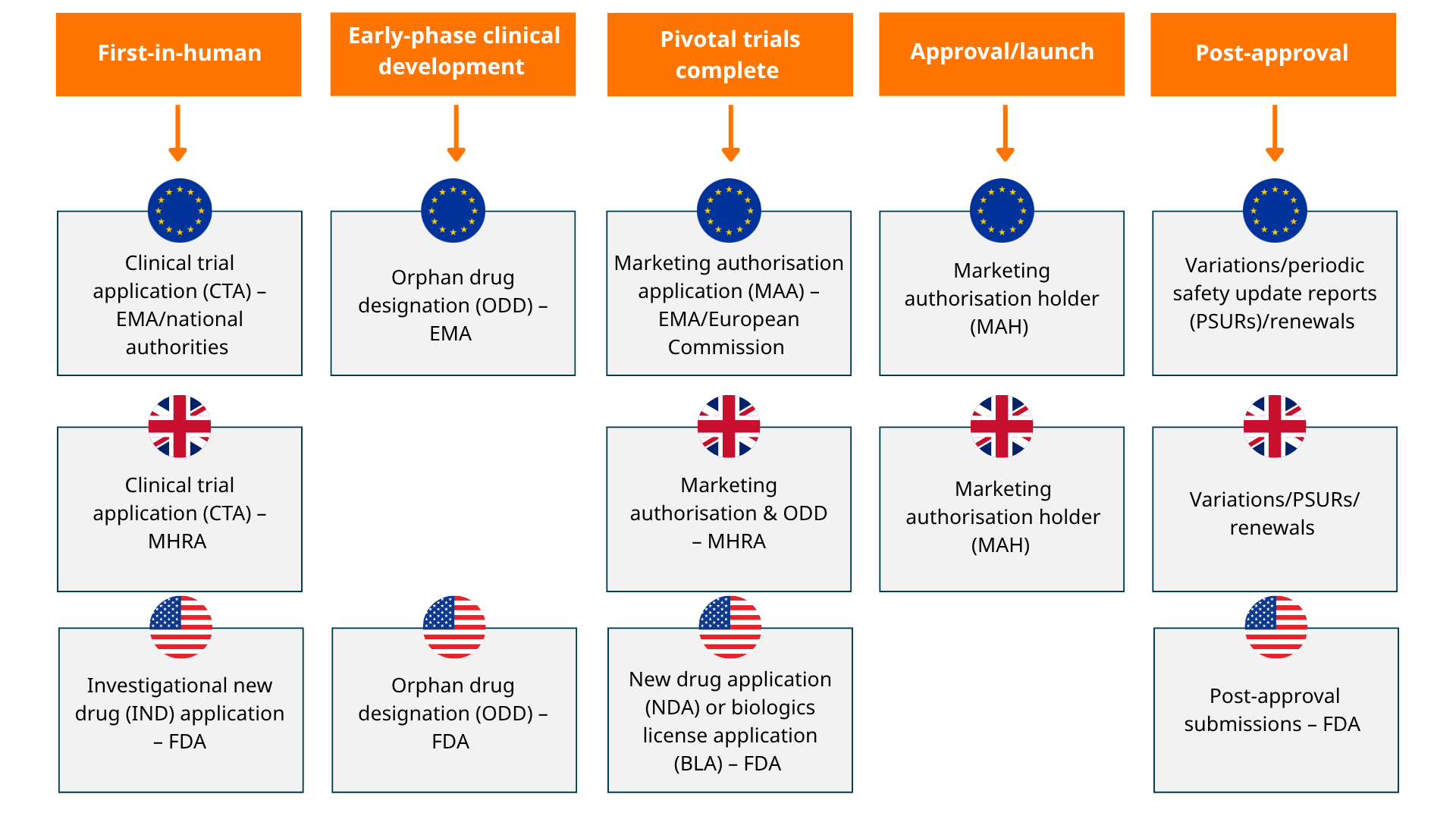
Clinical trial application (CTA)
Before testing an investigational medicine in humans, sponsors must secure authorization from the relevant health authority.
In the EU and UK, a clinical trial application (CTA) is one of the earliest types of regulatory submissions a sponsor will make, typically filed once enough non-clinical data exists to justify testing in people.
A clinical trial application typically includes:
- The trial protocol and investigator’s brochure.
- Manufacturing and quality data for the investigational product.
- Non-clinical safety data supporting first-in-human or continued dosing.
- Informed consent materials and ethics documentation.
The clinical trial application process by region
The clinical trial application process differs between regions:
- European Union: since January 2023, all new clinical trial applications must be submitted through the Clinical Trials Information System (CTIS), which allows a single application to be reviewed simultaneously across participating EU/EEA countries. The coordinated review is split into a scientific/technical part assessed by a lead country, and a national part assessed separately by each participating country.
- United Kingdom: UK sponsors submit their CTA through the Integrated Research Application System (IRAS), which coordinates a combined review by the MHRA and a Research Ethics Committee, producing a single national decision.
- United States: rather than a single “clinical trial application,” US sponsors submit an investigational new drug (IND) application.
Common clinical trial application challenges
Sponsors frequently underestimate how long it takes to prepare a multi-country CTA, particularly when trial design assumptions (such as comparator arms or standard-of-care choices) don’t reflect regional treatment norms. Delays also arise when responses to regulator queries are rushed or incomplete, extending review timelines further.
Investigational new drug (IND) applications
In the US, the equivalent early-stage filing is the investigational new drug application (IND). Unlike the EU or UK clinical trial application, an investigational new drug application is technically a request for exemption from the law that otherwise prohibits shipping an unapproved drug across state lines for the purpose of clinical testing. It is not an approval in the traditional sense.
The investigational new drug application process
The investigational new drug application process begins when a sponsor files with the FDA, triggering a mandatory 30-calendar-day review period. If the FDA does not place a clinical hold on the application within that window, the investigational new drug automatically becomes effective, and the sponsor may begin dosing participants.
A typical investigational new drug application includes:
- Animal pharmacology and toxicology data.
- Manufacturing information, including composition, stability, and quality controls.
- The clinical protocol, investigator qualifications, and commitments around informed consent and institutional review board oversight.
Common investigational new drug application challenges
Many sponsors request a pre-IND meeting with the FDA before filing, which is widely considered one of the most valuable steps for aligning on the nonclinical package, proposed starting dose, and manufacturing plan. Skipping this step increases the risk of a clinical hold, which can significantly delay a development program.
Orphan drug designation (ODD)
For sponsors developing treatments for rare diseases, orphan drug designation is a regulatory status — not a marketing approval — that unlocks incentives designed to make otherwise commercially challenging programs viable. It typically runs in parallel with, or ahead of, later-stage clinical development rather than sitting within the standard sequence of regulatory submissions.
Orphan drug designation criteria
Orphan drug designation criteria differ between the US and EU:
- FDA orphan drug designation: a disease or condition must affect fewer than 200,000 people in the US or be one where development costs cannot reasonably be recovered from US sales.
- EMA orphan drug designation: the condition must affect no more than 5 in 10,000 people in the EU, must be life-threatening or chronically debilitating, and the sponsor must generally show the medicine offers a “significant benefit” over existing treatments where one already exists.
Benefits and timing
Both the FDA and EMA typically review applications within around 90 days, though the EU adds a further step in which the European Commission must formally ratify a positive opinion. Successful designation can bring market exclusivity, fee waivers, tax credits, and additional regulatory support.
Common orphan drug designation challenges
The most frequent stumbling blocks are weak prevalence justification (often due to limited rare disease epidemiological data) and, in the EU, failing to adequately demonstrate significant benefit over existing treatments.
Marketing authorization application (MAA): EU and UK
Once pivotal clinical trials are complete, sponsors move to the marketing authorization application — the submission that seeks formal permission to market and sell a medicine. This is arguably the most complex of all the types of regulatory submissions, since it must demonstrate that a medicine is safe, effective, and manufactured to consistent quality standards.
EU marketing authorization application
The EU marketing authorization application can follow several routes. Many products — particularly biologics and rare disease treatments — must go through the centralized procedure, in which the Committee for Medicinal Products for Human Use (CHMP) evaluates the application against a fixed 210 “active” day timeline for a standard authorisation (with additional days paused for the sponsor to answer questions). For an accelerated authorisation, the timeline is 150 days.
A positive opinion is generally followed by a European Commission decision within around 67 days. Products not required to use the centralized procedure may instead use the national, mutual recognition, or decentralized procedures, which involve individual EU member states rather than a single EU-wide decision.
UK marketing authorization
Since leaving the EU regulatory framework, sponsors need a separate UK marketing authorization, obtained through one of several routes:
- The UK national procedure, with a standard 150-day assessment timeline.
- The International Recognition Procedure (IRP), which allows the MHRA to take into account an existing marketing authorization from a recognised reference regulator, including the EU, Australia, Canada, Japan, Switzerland, Singapore and the US. The IRP replaced the EC Decision Reliance Procedure and incorporates the former Mutual Recognition/Decentralised Reliance Procedure.
Common UK/EU marketing authorization challenges
Missing a clarification deadline during the UK’s 150-day national procedure can trigger an automatic refusal, forcing sponsors to restart the process. In the EU, gaps in manufacturing or quality data (Module 3 of the CTD) are a frequent source of delay, especially for sponsors whose data package was originally built around FDA expectations.
Marketing authorization in the US: NDA vs BLA
In the US, there is no single FDA marketing authorization filing; instead, sponsors submit either a new drug application (NDA) or a biologics license application (BLA), depending on the type of product.
New drug application (NDA)
A new drug application is used for small-molecule drugs. After pivotal trial data is complete, sponsors typically hold a pre-NDA meeting with the FDA, then submit the application as an electronic dossier along with the required user fee. The FDA conducts a filing review (roughly 60 days) to confirm the application is complete, followed by a substantive review of safety and efficacy data.
The NDA is separate from the investigational new drug application: the IND is filed before human trials begin and simply grants permission to start dosing, whereas the NDA is filed years later, once pivotal trials are complete, and seeks permission to market the drug commercially. In short, the investigational new drug submission opens the door to clinical testing, while the new drug application is the filing that can take a drug from the clinic to the pharmacy shelf.
Biologics license application (BLA)
A biologics license application is used for biologics such as vaccines, cell and gene therapies, and other complex products. It follows a similar overall biologics license application process to the NDA — pre-submission meeting, electronic filing, filing review, and substantive review — but the standard for approval focuses on demonstrating the product is safe, pure, and potent, and that the manufacturing facility meets the required standards.
Common US marketing authorization challenges
Both pathways can result in a Complete Response Letter if the FDA identifies deficiencies, requiring sponsors to address the issues and resubmit. Facility inspections tied to manufacturing data are a common source of last-minute delay for sponsors relying on contract manufacturers.
The marketing authorization holder
A distinguishing feature of the EU and UK systems, with no direct US equivalent, is the requirement that every approved medicine have a designated marketing authorization holder: a legal entity based in the relevant jurisdiction that carries ongoing legal and regulatory responsibility for the product.
Responsibilities of marketing authorization holders
Marketing authorization holders are accountable not just for the initial submission, but for the medicine’s entire lifecycle. Typical responsibilities include:
- Maintaining compliance with good manufacturing, clinical, and pharmacovigilance practices.
- Managing post-market safety monitoring and periodic safety reporting.
- Overseeing drug labeling, packaging, and supply chain compliance.
- Submitting and managing variations, renewals, and other post-approval regulatory submissions.
For sponsors without an established presence in the EU or UK — including many US-based biotech companies — appointing a marketing authorization holder is a significant undertaking that is best planned well in advance of submission, since the options for putting the right structure in place narrow considerably closer to filing.
Post-approval submissions: keeping a medicine compliant
Approval is not the end of the regulatory submission process. Once a medicine is on the market, further regulatory submissions are required to keep it compliant, which is why treating the regulatory submission process as ongoing rather than a one-time event is essential:
- Variations: any change to an approved product — from a minor drug labeling update to a significant manufacturing change — must be submitted as a variation, with the level of scrutiny depending on how significant the change is.
- Periodic safety update reports: these documents reassess a medicine’s risk-benefit balance at defined intervals, incorporating new safety data gathered since approval.
- Renewals: EU marketing authorizations are typically reviewed for renewal after an initial period following approval.
Sponsors of orphan-designated medicines in the EU also face additional obligations, including annual development reports to the European Medicines Agency covering clinical progress and any changes to prevalence or benefit data.
Common regulatory submission challenges across jurisdictions
Across all the types of regulatory submissions covered in this guide, several challenges tend to recur for emerging biotech and pharma sponsors:
- Clinical trial designs built primarily around FDA expectations can generate additional questions from EU and UK regulators if comparators or standard-of-care assumptions don’t reflect local treatment norms.
- Manufacturing and quality documentation gaps are a leading cause of delay across EU and UK marketing authorization application
- Coordinating separate EU and UK submission timelines can create duplicated work and misaligned review cycles.
- Smaller sponsors often lack the in-house regulatory capacity to prepare a full multidisciplinary dossier within tight statutory deadlines.
- Rare disease programs face particular difficulty assembling a coherent clinical data package from limited or heterogeneous data sources.
Building a regulatory submission strategy that works across markets
Understanding the different types of regulatory submissions — and how they map to each stage of the product lifecycle — is the first step toward building a coordinated, cross-jurisdictional development plan.
While clinical trial applications, marketing authorization applications, and post-approval regulatory submissions all share a common purpose across the UK, EU, and US, the practical requirements, timelines, and documentation expectations differ enough that a one-size-fits-all approach rarely works.
At TMC Consulting, we specialize in helping emerging biotech and pharma companies navigate this complexity, from preparing clinical trial and marketing authorization applications to acting as a marketing authorization holder for sponsors without an established presence in the EU or UK.
If you’re planning your next regulatory submission and want to make sure your strategy accounts for every stage of the process, our experts are here to help.
Regulatory submission FAQs
What is a clinical trial application?
A clinical trial application (CTA) is a regulatory submission filed in the EU or UK to gain authorization before testing an investigational medicine in humans. It includes the trial protocol, manufacturing data, and non-clinical safety evidence. It is typically one of the earliest types of regulatory submissions in a product’s lifecycle.
What is an investigational new drug application?
An investigational new drug application (IND) is the US equivalent of a clinical trial application. Rather than seeking approval, it requests exemption from the law prohibiting interstate shipment of an unapproved drug, allowing sponsors to begin human dosing once the FDA’s 30-day review period passes without a clinical hold.
What is orphan drug designation?
Orphan drug designation is a regulatory status — not a marketing approval — granted to medicines treating rare diseases. It unlocks incentives such as marke exclusivity, fee waivers, and tax credits. It typically runs alongside later-stage clinical development rather than sitting within the standard sequence of regulatory submissions.
What is a marketing authorization application?
A marketing authorization application (MAA) is the submission filed after pivotal trials are complete, seeking formal permission to market and sell a medicine in the EU or UK. It must demonstrate safety, efficacy, and consistent manufacturing quality, making it one of the most complex types of regulatory submissions.
What is a marketing authorization holder?
A marketing authorization holder (MAH) is a legal entity based in the EU or UK that carries ongoing responsibility for an approved medicine, including compliance, safety monitoring, and post-approval regulatory submissions. There is no direct US equivalent to this role.
What’s the difference between a clinical trial application and an investigational new drug application?
Both authorize human testing, but a clinical trial application applies in the EU and UK via CTIS or IRAS, while an investigational new drug application applies in the US via the FDA. The core difference is procedural: the IND uses a 30-day automatic-effect clock, while CTAs involve active coordinated review by regulators.
Do I need orphan drug designation before submitting a marketing authorization application?
No, orphan drug designation and a marketing authorization application are separate processes. Orphan drug designation is typically pursued during earlier clinical development to access incentives, while the marketing authorization application is filed later, once pivotal trial data is complete.
How is a new drug application different from a biologics license application?
A new drug application (NDA) is used for small-molecule drugs, while a biologics license application (BLA) is used for biologics like vaccines and gene therapies. Both follow a similar FDA review process, but the BLA approval standard focuses on safety, purity, and potency rather than only safety and efficacy.
Why would a sponsor need a marketing authorization holder if they’re US-based?
US sponsors without an EU or UK presence must appoint a marketing authorization holder to legally hold and maintain their authorization in those regions. This role carries ongoing compliance and pharmacovigilance responsibilities, so it should be arranged well before submission.
Does the regulatory submission process end once a medicine is approved?
No, approval marks the start of a new phase of the regulatory submission process. Marketing authorization holders must continue submitting variations, periodic safety update reports, and renewals to keep the medicine compliant throughout its time on the market.