
Early-phase clinical trials are among the most consequential steps in drug development — particularly when the mechanism is novel, the patient population is small, and the margin for error is narrow.
For first-in-human (FIH) and other complex early-phase studies, the quality of the safety rationale within clinical trial applications (CTA) often determines how quickly a study progresses — or whether it progresses at all.
Regulatory agencies are applying greater scrutiny to safety in clinical trial application submissions, driven by increasing complexity from novel advanced therapeutic modalities, rare disease indications, accelerated development pathways and limited preclinical precedent. The agencies are not simply checking that data exists. They are assessing whether you have interpreted the data correctly, anticipated the risks and built a coherent strategy to manage them.
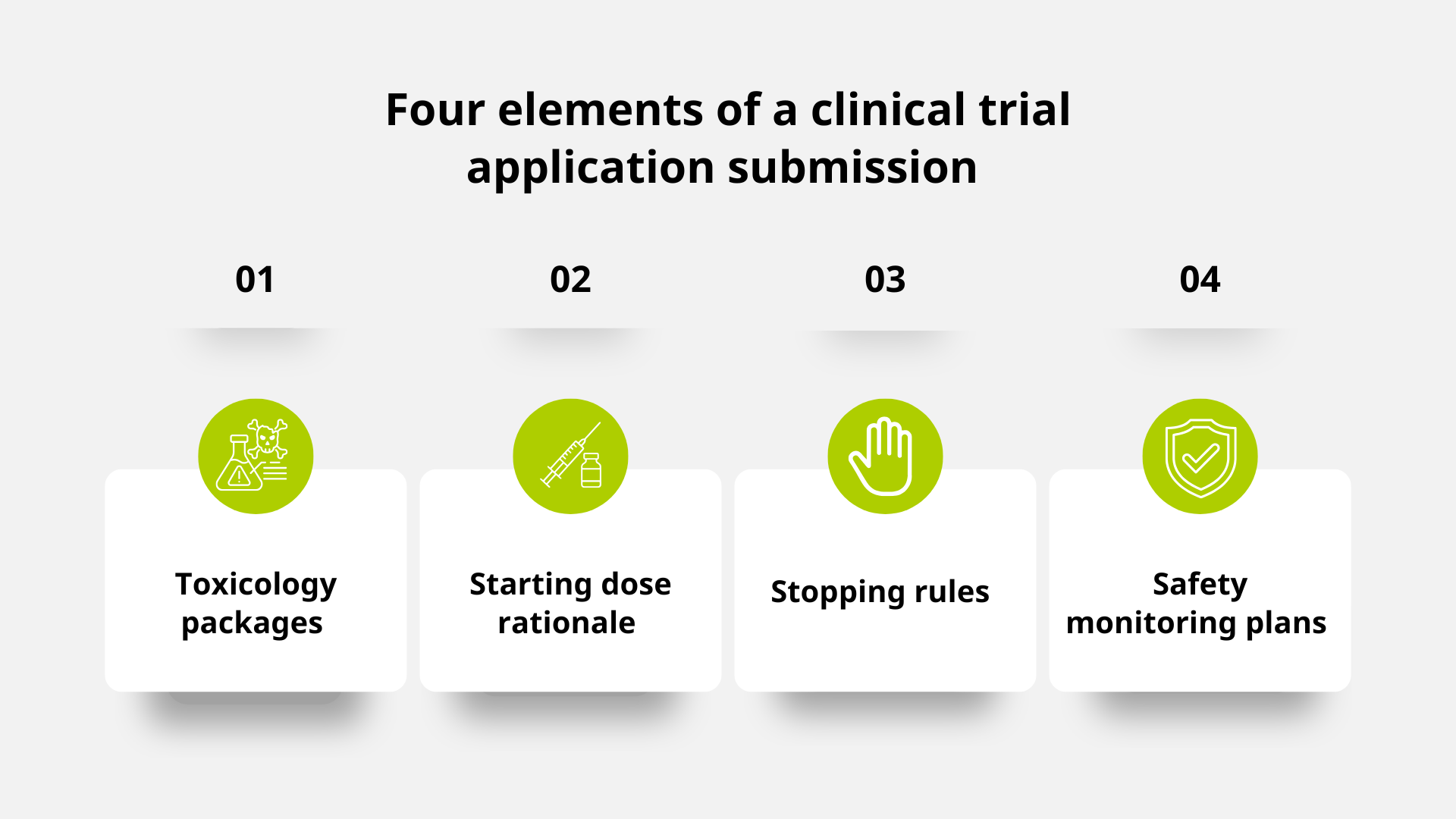
Whether you are working with an internal team or partnering with a pharma services company, this blog explains how to approach four interconnected elements of your safety submission — toxicology packages, starting dose rationale, stopping rules and safety monitoring plans — in a way that builds regulatory confidence and reduces the risk of delays.
Why safety is where clinical trial application submissions succeed or fail
A CTA submission that lacks a well-articulated safety strategy is likely to generate information requests from regulators, which in turn delays study approval and first patient enrolment. These requests are rarely about missing data — more often, they reflect a perception that the sponsor has not fully engaged with the risk.
This matters particularly in early-phase development for several reasons:
- Limited data availability. For novel targets, rare diseases and advanced therapeutic modalities such as cell and gene therapies, preclinical data may be sparse, derived from imperfect animal models or difficult to translate directly into human dose predictions.
- Novel mechanisms of action. Therapies that work through new biological pathways (for example, immune cell re-engineering or gene editing) may produce delayed, non-linear or unexpected toxicity profiles that standard models are not designed to capture.
- Small patient populations. In rare disease settings, statistical power is inherently limited, and every patient matters. Regulators expect sponsors to have invested seriously in understanding and mitigating risk before first human exposure.
- Accelerated timelines. Breakthrough Therapy Designation, Priority Medicines (PRIME) and equivalent pathways can compress development, but they do not reduce the expectation for safety rigour. If anything, they raise it.
Understanding these dynamics helps you approach the regulatory submission process not as a compliance exercise but as a communication challenge: how do you present what you know — and what you don’t — in a way that gives regulators confidence?
Presenting your toxicology package effectively
The toxicology package is the evidential foundation of any FIH or complex early-phase CTA submission. Regulators are looking at what the studies show and assessing whether the programme is appropriately designed, conducted and interpreted.
Cover the right studies for your modality
The International Council for Harmonisation (ICH) guidelines — particularly ICH M3(R2), S6 and S9 — provide the framework, but how you apply them depends heavily on your therapeutic class. A small molecule oncology asset may require a different package than a viral vector-based gene therapy or an ex vivo cell therapy. Be explicit about which guidelines you are following and why, then address any deviations clearly.
Address gaps transparently
Regulators expect data gaps in early-phase clinical trial application submissions, particularly for novel modalities. The mistake is leaving these gaps unexplained. For each area where data is limited or absent, acknowledge this, describe why the data is not available, and explain what steps have been taken to characterise risk in the absence of complete information. This might include in vitro studies, cross-referencing published literature on related mechanisms, or modelling and simulation.
Integrate across species and models
Where multiple preclinical species have been used, present a synthesis of findings rather than a series of isolated study reports. Regulators want to understand the overall picture: which findings were consistent across models, which were not, and what that means for human risk.
Contextualise findings, not just data
A list of adverse findings in preclinical species is not a safety rationale. For each significant toxicological observation, explain its mechanism where understood, its reversibility, whether it is monitored in the human study and what clinical significance it may have at the proposed starting dose. This level of interpretation is what separates strong clinical trial application submissions from thin ones.
Building a credible starting dose rationale
The starting dose is one of the most scrutinised elements of any FIH clinical trial application. Regulators want to be satisfied that the dose is appropriately cautious, scientifically justified and derived from a systematic analysis of the available preclinical data — not simply selected for convenience or competitive positioning.
Use a transparent, documented methodology
The most common approaches for starting dose calculation include the No Observed Adverse Effect Level (NOAEL) method (commonly used for small molecules), the Minimum Anticipated Biological Effect Level (MABEL) approach (increasingly favoured for high-risk biologics and novel modalities) and pharmacokinetic/pharmacodynamic (PK/PD) modelling. For complex or high-risk therapies, a hybrid approach that triangulates across multiple methods is often the most defensible.
Apply appropriate safety factors
Document all conversion factors, safety margins and allometric scaling calculations clearly, and justify them. For novel modalities — particularly those with the potential for cytokine release, severe immune reactions or long-term biodistribution — regulators may expect more conservative safety factors than would be applied to well-characterised small molecules.
Account for the most sensitive preclinical species
Where data from different species show different toxicity profiles, the starting dose should generally be based on the most sensitive species unless there is a well-justified scientific rationale for not doing so. Explain your reasoning explicitly.
Link the starting dose to your monitoring strategy
The starting dose rationale should not be presented in isolation. Demonstrate how it connects to the safety monitoring plan: what pharmacokinetic sampling will confirm systemic exposure at the starting dose, which biomarkers will signal early pharmacological activity and what clinical observations will be sought before escalation proceeds. This integrated narrative significantly strengthens the overall safety package.
Designing stopping rules that demonstrate real risk management
Stopping rules — also referred to as dose-limiting toxicity (DLT) criteria and study stopping criteria — are a critical but often underdeveloped component of clinical trial applications, particularly for sponsors new to early-phase clinical development.
Regulators and data monitoring committees (DMCs) view stopping rules as the primary safeguard against participant harm once a study is underway. Vague or overly generic stopping rules create the impression that safety has not been fully considered, which tends to generate questions.
Define DLTs precisely and modality-appropriately
Avoid simply listing Common Terminology Criteria for Adverse Events (CTCAE) Grade 3 or 4 events as DLTs without further qualification. For immunotherapy agents, consider whether cytokine release syndrome should be graded using a disease-specific scale, such as the American Society for Transplantation and Cellular Therapy (ASTCT) consensus criteria, rather than generic CTCAE grades. For therapies with expected on-target effects in normal tissue, distinguish between on-target toxicity and off-target findings. The more specific and scientifically grounded your DLT criteria, the more confidence regulators will have that you understand your own asset.
Separate DLT criteria from study stopping criteria
DLTs typically apply within an individual dose cohort and trigger review by the safety committee. Study stopping criteria represent a higher threshold — events so serious, or patterns so concerning, that the entire study should halt pending review. Both sets of criteria should be clearly articulated and proportionate to the risk level of your modality.
Address unresolvable uncertainties through design
For novel modalities where the safety profile is poorly characterised, consider building in sentinel dosing (treating a lead patient before enrolling the remainder of the cohort), staggered enrolment between cohorts and pre-specified observation windows. These operational cautions are evidence that you have thought carefully about how to protect participants in the face of uncertainty, which regulators typically respond positively to.
Align stopping rules with the DMC charter
The stopping rules in the protocol must be consistent with the independent safety review process established in the DMC charter. Disconnects between these two documents — for example, different thresholds for triggering a safety review — are a common source of regulatory questions and can delay approval.
Constructing a safety monitoring plan that reassures regulators
A well-constructed safety monitoring plan does two things simultaneously: it protects trial participants, and it demonstrates to regulators that the sponsor has a structured, proactive approach to safety rather than a reactive one.
Tailor the plan to your modality
Generic safety monitoring plans rarely satisfy regulators for complex early-phase studies. The plan should reflect the specific risk profile of your therapy. For a cell therapy with the potential for prolonged in vivo persistence, long-term follow-up obligations, including the approach to detecting delayed adverse events, should be clearly specified. For an immunotherapy with cytokine release risk, the plan should detail the frequency and timing of cytokine panels, who reviews them, at what threshold an escalation is triggered and what clinical interventions are available on site.
Specify the governance structure
Identify the roles and responsibilities for safety review: the principal investigators, the medical monitor, the sponsor’s safety team, the independent DMC and any relevant regulatory bodies. Define the frequency of scheduled safety reviews, the mechanism for unscheduled reviews if a safety signal emerges and the escalation pathway from site level to sponsor level to the DMC.
Address the interface between safety and dose escalation
For studies with adaptive dose escalation designs, the relationship between safety data review and escalation decisions should be clearly defined in both the protocol and the monitoring plan. If a statistical model, such as the Bayesian Optimal Interval (BOIN) or Continual Reassessment Method (CRM), is being used to guide escalation, the safety review process should be integrated with, rather than separate from, the model’s outputs.
Align safety monitoring with regulatory submission process requirements
The monitoring plan should reference any applicable expedited reporting requirements — for example, suspected unexpected serious adverse reactions (SUSARs) — and specify how pharmacovigilance obligations will be met for a first-in-human study. Regulators in the UK, EU and US each have specific expectations around safety reporting timelines and formats; aligning with all relevant jurisdictions from the outset is particularly important for sponsors planning multi-regional early-phase development.
The role of early regulatory engagement
None of the above elements operates in isolation. The most effective way to minimise safety concerns across the regulatory submission process is to engage with regulators before submission, not after a rejection.
Pre-submission scientific advice meetings — whether with the Medicines and Healthcare products Regulatory Agency (MHRA), the European Medicines Agency (EMA) or the US Food and Drug Administration (FDA) — allow sponsors to validate safety assumptions, understand agency-specific expectations for novel modalities and resolve areas of uncertainty before the clock starts ticking. For FIH studies in rare diseases or with advanced therapeutic modalities, this investment almost always pays for itself in avoided delays.
Early engagement also provides a record that the agency’s views have been considered in the study design, which can improve the ‘first impression’ of the sponsor and the relationship with the agency — strengthening the submission narrative to make it more positive for a faster approval.
Safety as a strategic enabler
Minimising safety concerns in early-phase clinical trial application submissions is not simply about satisfying a regulatory checklist. It is about demonstrating that you understand your own programme — its risks, its uncertainties and your plan for managing both.
Sponsors who invest in building a coherent, well-integrated safety package tend to move faster through the regulatory submission process, attract stronger clinical partnerships and build the kind of regulatory credibility that carries forward into later development phases and, ultimately, drug commercialisation.
The practical steps (thorough toxicology integration, transparent starting dose justification, precise stopping rules and a tailored monitoring plan) are not difficult to execute with the right expertise and structured approach. The challenge, for many sponsors, is having the internal capacity to do all of this well while simultaneously managing the broader demands of early-phase development — which is where engaging a specialist pharma services company can make a material difference to both quality and speed.
TMC Clinical supports sponsors through all stages of early-phase clinical development, including preparation and submission of clinical trial applications for first-in-human and other complex studies.
As a specialist pharma services company, we combine deep regulatory, safety and clinical expertise with the operational agility to help you move efficiently from development through to global pivotal trials. Our team works alongside yours to build the safety rationale, monitoring infrastructure and submission-ready documentation that regulators need to approve your study with confidence.
To find out how we can support your early-phase clinical trial application submissions, speak to the team today at connect@tmcpharma.com.