
Orphan drug designation for emerging biotech companies: your guide to FDA and EMA approval
Developing medicines for rare diseases presents unique scientific, regulatory, and commercial challenges. Small patient populations mean limited revenue potential, higher per-patient development costs, and greater uncertainty about clinical and regulatory pathways.
For emerging biotech companies operating with finite resources, these factors can make the difference between a viable programme and one that never reaches patients.
Orphan drug designation (ODD) is a regulatory tool designed to address these challenges head-on.
By providing incentives such as market exclusivity, fee waivers, tax credits, and regulatory support, orphan designation makes it financially and scientifically feasible to develop therapies for conditions that would otherwise be commercially unviable.
This guide walks you through everything you need to know about ODD in the US and EU — from eligibility criteria and application processes to post-designation obligations and drug commercialization strategies.
Contents:
- What is orphan drug designation — and who qualifies?
- US vs EU: key differences in orphan development criteria
- FDA orphan drug designation: process, benefits, and timeline
- EMA orphan drug designation: process, benefits, and timeline
- From designation to approval: mapping your drug development pathway
- Post-designation obligations: how to maintain orphan drug status
- Common orphan drug designation pitfalls — and how to avoid them
- Building your drug commercialization strategy around orphan status
- Next steps: how to move forward with confidence
1. What is orphan drug designation — and who qualifies?
ODD is a regulatory status granted to medicines intended to treat, diagnose, or prevent rare, life-threatening, or chronically debilitating conditions. The designation is not a marketing approval — it does not mean your medicine is safe or effective — but it unlocks a suite of incentives that de-risk development and improve your chances of success.
Eligibility hinges on meeting specific orphan drug designation criteria set by regulatory agencies:
US Food and Drug Administration (FDA):
- Disease or condition affects fewer than 200,000 people in the US
- Or be for a disease where development costs cannot reasonably be recovered from US sales
European Medicines Agency (EMA):
- Disease or condition affects no more than 5 in 10,000 people in the EU
- Condition must be life-threatening or chronically debilitating
- No satisfactory treatment exists, or the new medicine offers significant benefit over existing treatments
Sponsors can apply for designation at any point during development, though doing so early — often before or during Phase 2 trials — maximises access to incentives.
Once granted, designation remains valid as long as the medicine continues to meet the criteria and you comply with regulatory obligations. The designation can be withdrawn if a satisfactory treatment becomes available (EU only) or prevalence increases beyond the threshold.
2.US vs EU: key differences in orphan development criteria
While the FDA and EMA share the goal of encouraging orphan development, their orphan drug designation criteria differ in meaningful ways that affect how you structure your application and development plan.
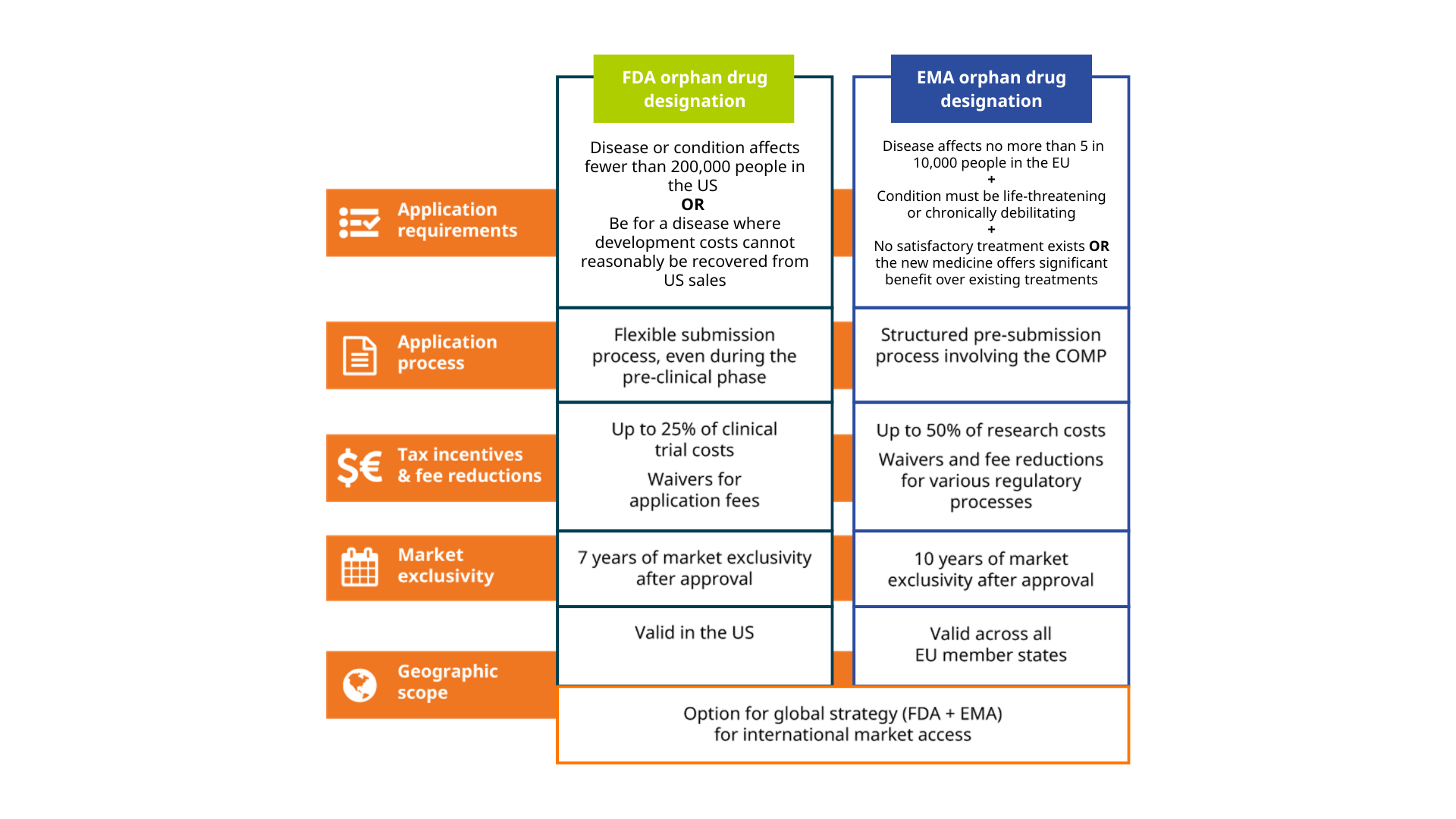
The most critical difference is the EMA’s “significant benefit” requirement. If a satisfactory treatment already exists in the EU, you must demonstrate that your medicine offers clinically relevant advantages — such as improved efficacy, safety, tolerability, or convenience. This requires careful positioning and often comparative data.
By contrast, the FDA, only requires a reasonable expectation of efficacy without needing to prove superiority over existing treatments.
The choice between applying for FDA or EMA ODD largely depends on your target market, the geographic scope of the product, and your drug development stage. If you are building a US/EU pharma strategy, aligning your development plan to meet both FDA and EMA criteria from the outset is essential.
FDA orphan drug designation: process, benefits, and timeline
The FDA orphan drug designation pathway is one of the most well-established incentive programmes in rare disease development. Sponsors can apply at any time during development, including before submitting an investigational new drug application, during early-phase clinical trials, or even in parallel with a marketing application.
Applications are submitted electronically via the FDA’s Orphan Drug Designation Information System (ODDIS). The regulatory submission must include a description of the disease and its prevalence in the US, scientific rationale supporting reasonable expectation of efficacy, and relevant preclinical or clinical data. FDA has 90 days to review the application and will issue either a designation letter or a denial letter with reasons.
Once granted, FDA orphan drug designation provides several powerful incentives:
- Seven years of market exclusivity for the designated indication upon approval
- Prescription Drug User Fee Act (PDUFA) fee waiver, saving millions in application costs
- Tax credits for up to 25% of qualified clinical testing costs
- Eligibility for orphan drug grants to support clinical development
- Protocol assistance from FDA reviewers throughout development
For emerging biotech companies operating with limited budgets, these incentives can substantially reduce development costs and regulatory risk. The key is to apply early, justify prevalence carefully, and maintain open communication with FDA throughout development.
EMA orphan drug designation: process, benefits, and timeline
The EMA orphan drug designation pathway shares similar goals with the FDA program but differs in key procedural and substantive ways. As with the US, you can apply at any time during development, though most sponsors do so before or during Phase 2 to maximize fee reductions and protocol assistance.
Applications are submitted electronically via the EMA’s Regulatory & Scientific Information Management Platform (IRIS). The regulatory submission must include detailed sections covering the disease description, prevalence data in the EU, scientific rationale, and evidence of significant benefit if a satisfactory treatment already exists.
The Committee for Orphan Medicinal Products (COMP) then reviews applications at monthly meetings, with a typical review timeline of around 90 days from submission.
Once granted, EMA orphan drug designation unlocks substantial incentives:
- Ten years of market exclusivity for the authorised orphan indication in the EU
- 75–100% fee reductions for pre-authorization procedures (scientific advice, protocol assistance), depending on SME status and procedure
- Fee incentives for marketing authorization applications, including a 100% fee reduction for designated orphan medicinal products submitted by SMEs
- Procedure‑specific reductions or waivers for certain post‑authorisation activities, especially when the holder has SME status
- Use of the centralised procedure, leading to a single EU‑wide marketing authorisation once granted
If you’re advancing your EU pharma strategy, early engagement with COMP via protocol assistance is highly recommended. This allows you to address questions before regulatory submission and align your development plan with EMA expectations.
3. From designation to approval: mapping your drug development pathway
Securing ODD is just the beginning. The next critical milestone is obtaining authorization, which allows your medicine to reach patients and generate revenue.
Although development timelines vary between program, most orphan medicines follow a similar pathway. Applying for ODD early enables you to access regulatory support and financial incentives throughout clinical development.
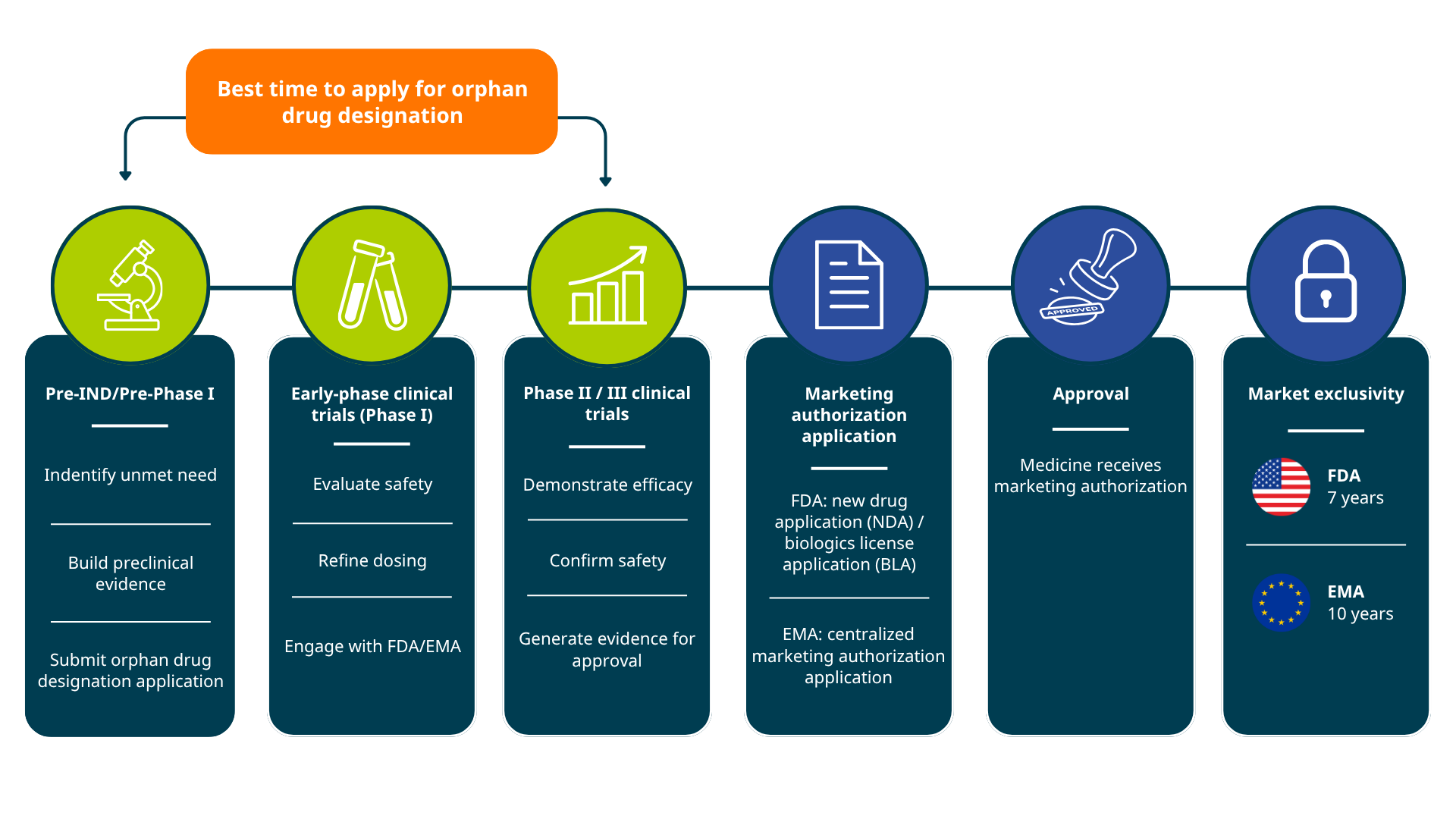
US pathway:
After completing early-phase clinical development and pivotal trials, you must submit one of the following:
- New drug application (NDA) for small molecules.
- Biologics license application (BLA) for biologics.
The FDA will review the application for safety, efficacy, and quality. If approved, the medicine receives marketing authorization and seven years of market exclusivity for the orphan indication.
EU pathway:
All orphan medicines must go through the centralized procedure. Sponsors submit a marketing authorization application to the EMA for scientific assessment by the Committee for Medicinal Products for Human Use (CHMP). If the European Commission grants approval, the medicine benefits from:
- Authorization valid across all EEA countries.
- Ten years of market exclusivity for the orphan indication.
Both agencies offer accelerated pathways for eligible medicines.
The FDA’s fast track, breakthrough therapy, and accelerated approval programs can shorten development timelines. Similarly, the EMA offers conditional marketing authorization and authorization under exceptional circumstances for medicines addressing unmet needs where comprehensive data cannot be provided.
Throughout this journey, you must submit clinical trial applications to regulatory authorities before initiating each trial phase, maintain ongoing safety reporting, and fulfil any post-approval commitments.
4. Post-designation obligations: how to maintain orphan drug status
Orphan designation is not a one-time event. You must fulfil ongoing obligations to maintain your designation and remain compliant with regulatory requirements.
In the EU, sponsors of designated orphan medicines must submit annual reports on medicine development to the EMA. These reports should include the status of clinical development, any changes to the development plan, and updates on prevalence or benefit criteria. Failure to submit these reports can result in withdrawal of your designation.
In the US, while there is no formal annual reporting requirement, sponsors are expected to maintain records and update the FDA on development progress. Orphan designation can be withdrawn if the medicine no longer meets the prevalence threshold or if you fail to maintain compliance with regulatory obligations.
Designations can also be transferred during mergers, acquisitions, or other changes in sponsorship. Both the FDA and EMA provide procedures for transferring orphan designations, but you must notify the relevant agency and submit updated sponsor information.
If you’re managing multiple regulatory submissions across jurisdictions, maintaining a clear timeline of obligations and deadlines is essential to avoiding lapses in status.
5. Common orphan drug designation pitfalls — and how to avoid them
Even with strong scientific rationale, sponsors can encounter obstacles when applying for orphan designation and maintaining it afterwards. Understanding these common pitfalls — and how to avoid them — can save time, money, and frustration.
Delayed regulatory submission
You should submit the regulatory submission as early as feasible, ideally before or around Phase 2. Waiting too long to apply for orphan designation means missing out on incentives:
- Fee waivers, tax credits, and protocol assistance.
- Other support programmes while your development plan is still flexible.
Weak prevalence justification
Epidemiological data for rare diseases is often limited or inconsistent. To avoid rejection:
- Use multiple credible sources (peer-reviewed literature, patient registries, expert opinions).
- Clearly justify your methodology and assumptions in the prevalence section of the ODD application.
- Consider engaging with patient advocacy groups to access real-world data.
Failing to demonstrate significant benefit (EU)
Where a satisfactory treatment exists, your ODD application must show that the medicine has the potential to provide a significant benefit. To strengthen this:
- Develop and articulate your benefit claim as part of the EU orphan designation dossier.
- Use available comparative or supportive data (clinical, observational, or robust preclinical) to substantiate the claimed advantage.
- After designation, use protocol assistance to refine your strategy for confirming significant benefit at the time of marketing authorization.
Missing reporting deadlines
Once designation is granted, annual reports (EMA) and other post-designation obligations have strict deadlines (e.g. EMA annual reports within two months of the designation anniversary, and optional joint FDA/EMA annual reports):
- Set up internal tracking systems and calendar reminders tied to the designation grant date.
- Work with a regulatory partner or assign a regulatory lead or partner to prepare and submit reports via IRIS and FDA systems.
Misaligned US/EU development plans
Designing trials that satisfy only one agency can delay approval or complicate ODD maintenance:
- Build your early-phase clinical trial program to meet both FDA and EMA expectations.
- Align endpoints, patient populations, and safety monitoring from the outset.
6. Building your drug commercialization strategy around orphan status
Orphan designation shapes not only your regulatory pathway but also your drug commercialization strategy. Understanding how exclusivity windows, pricing dynamics, and market access considerations interact is essential to maximizing the commercial value of your medicine.
Market exclusivity
Market exclusivity is key to orphan drug commercialization. In the US, seven years of exclusivity prevents FDA approval of the same drug for the same indication. In the EU, ten years of exclusivity provide even longer protection, with the possibility of an additional two years if you comply with an agreed pediatric investigation plan (PIP) — the US equivalent of the pediatric study plan (PSP).
These windows give you time to establish market presence, negotiate pricing and reimbursement, and build relationships with patient advocacy groups before competitors can enter.
Rare disease communities are tight-knit and highly influential; engaging early with patient advocacy groups can accelerate recruitment, inform trial design, and support market access post-approval.
Pricing and payer evidence
Pricing for orphan medicines often reflects the high per-patient development costs and small addressable populations. However, payers increasingly demand robust evidence of value — including patient-reported outcomes, real-world evidence, and long-term effectiveness data — meaning building a focused, payer-driven evidence plan alongside your clinical development program is essential.
Many companies under‑invest in payer‑relevant endpoints and real‑world data plans, then struggle to secure reimbursement or effectively sell their product when it reaches the market. To secure reimbursement, your clinical and evidence‑generation program must be designed from the outset to answer payer questions, not just satisfy regulators.
From 13 January 2028, sponsors of orphan products applying for EU marketing authorization will also need to submit a joint clinical assessment (JCA) dossier for health technology assessment (HTA), adding another layer of complexity that makes early dialogue with HTA bodies and careful evidence planning even more important.
Execution
If you don’t have internal commercial capabilities, working with a pharma services company can provide the expertise needed to execute your drug commercialization strategy, from market research and pricing to launch planning and field force deployment.
Specialist partners can help you integrate regulatory, HTA (including JCA), and payer evidence requirements into a single, coherent launch plan.
7. Next steps: how to move forward with confidence
Navigating ODD across the US and EU is complex, but the incentives and market opportunities make it a compelling strategy for emerging biotech companies.
By understanding the criteria, application processes, and post-designation obligations, you can build a drug development plan that maximizes regulatory support and commercial potential, enabling you to unlock fee waivers, tax credits, and protocol assistance.
The key is to start early. You should:
- Engage with the FDA and EMA as soon as you have preliminary data.
- Submit your regulatory submission for orphan designation before or during Phase 2 (pre-clinical if you have a robust animal model).
- Align your clinical development plan to meet both agencies’ expectations.
- Build a commercialization strategy that leverages your exclusivity window.
At TMC Pharma, we specialise in helping emerging biotech companies navigate the orphan designation process from start to finish.
Our team provides end-to-end support across regulatory strategy, clinical development, and drug commercialization — ensuring you have the expertise and resources needed to bring your medicine to patients.
We can also act as your marketing authorization holder (MAH), if you don’t have a presence in Europe, to ensure compliance with all local regulations. As an established EU/EEA-based MAH with SME status, TMC can be your EU/EEA representative — simplifying new drug approvals and helping you secure substantial discounts on EMA fees.
If you’re considering ODD for your program, reach out today to discuss how we can support your application and help you gain ODD status with the FDA or EMA.
FAQs: orphan drug designation
How long does FDA orphan drug designation take to approve?
The FDA has 90 days to review your orphan drug designation application submitted via the Orphan Drug Designation Information System (ODDIS). They will issue either a designation letter or a denial letter with reasons. Applying early, ideally before or during Phase 2, maximizes access to incentives throughout development.
How long does EMA orphan drug designation take to approve?
The EMA’s Committee for Orphan Medicinal Products (COMP) evaluates an orphan designation application within 90 days of validating your application. If the COMP adopts a positive opinion, the European Commission then has an additional 30 days to formally grant or refuse the designation.
What are the key orphan drug designation criteria for the FDA and EMA?
The FDA requires prevalence under 200,000 people in the US or unrecoverable development costs. The EMA requires prevalence under 5 in 10,000 in the EU, plus life-threatening or chronically debilitating conditions. The EMA also requires demonstrating significant benefit if satisfactory treatments already exist.
Can I apply for orphan drug designation during early-phase clinical trials?
Yes. You can apply for orphan drug designation at any development stage, including before including before any clinical work has started. Sponsors may apply based on robust pre‑clinical data and good disease models before investigational new drug (IND) submission, during early-phase clinical trials, or alongside marketing applications. Early application is recommended to maximize fee waivers, tax credits, and protocol assistance from regulatory agencies.
What happens if my orphan designation is withdrawn?
If withdrawn, you lose orphan incentives like market exclusivity and fee reductions. Withdrawal can occur if prevalence exceeds thresholds, satisfactory treatments become available (EU), or you fail post-designation obligations like annual reporting. Maintaining compliance and monitoring prevalence is essential to retaining status.
How does orphan drug designation affect my drug commercialization strategy?
Orphan designation provides seven years of market exclusivity in the US and up to 12 years in the EU, shaping your pricing, launch timing, and market access approach. It allows time to establish presence before competitors enter. Your drug commercialization strategy should leverage this window for payer negotiations and patient advocacy partnerships.
Do I need separate regulatory submissions for FDA and EMA orphan designation?
Yes. FDA and EMA require separate regulatory submissions via Orphan Drug Designation Information System (ODDIS) and Regulatory & Scientific Information Management Platform (IRIS), respectively. Each has distinct criteria, documentation requirements, and review processes. Aligning your development plan to meet both agencies’ expectations from the outset streamlines parallel development across US and EU markets.
What post-designation obligations must I fulfil to maintain orphan status?
EU sponsors must submit annual reports to the EMA covering development status, plan changes, and prevalence updates. US sponsors must maintain records and update the FDA on progress. Failure to comply can result in withdrawal. Managing multiple regulatory submissions across jurisdictions requires clear deadline tracking.
Can orphan designation be transferred if my company is acquired?
Yes. Both the FDA and EMA allow orphan designation transfers during mergers, acquisitions, or sponsorship changes. You must notify the relevant agency and submit updated sponsor information. Ensuring continuity of reporting obligations during transfer is critical to maintaining your designation without interruption.
Should I work with a pharma services company for my orphan drug application?
Working with a pharma services company can provide regulatory expertise, streamline submissions, and ensure compliance with post-designation obligations. This is especially valuable if you lack internal capabilities. A partner can also support your drug commercialization strategy from launch planning to field deployment.