
The European Medicines Agency (EMA) and the Medicines and Healthcare products Regulatory Agency (MHRA) assess applications on the totality of evidence.
That evidence package was assembled across years of early-phase clinical development. By the time a pre-submission team reviews the full picture, structural problems in that evidence base are usually too embedded to fix without high cost or significant delay.
This is why new drug approvals in the EU and UK are disproportionately shaped by early development decisions. The four areas below are where US sponsors seeking EU/UK approval most often create avoidable regulatory submission risk — and what to do about each while there is still time.
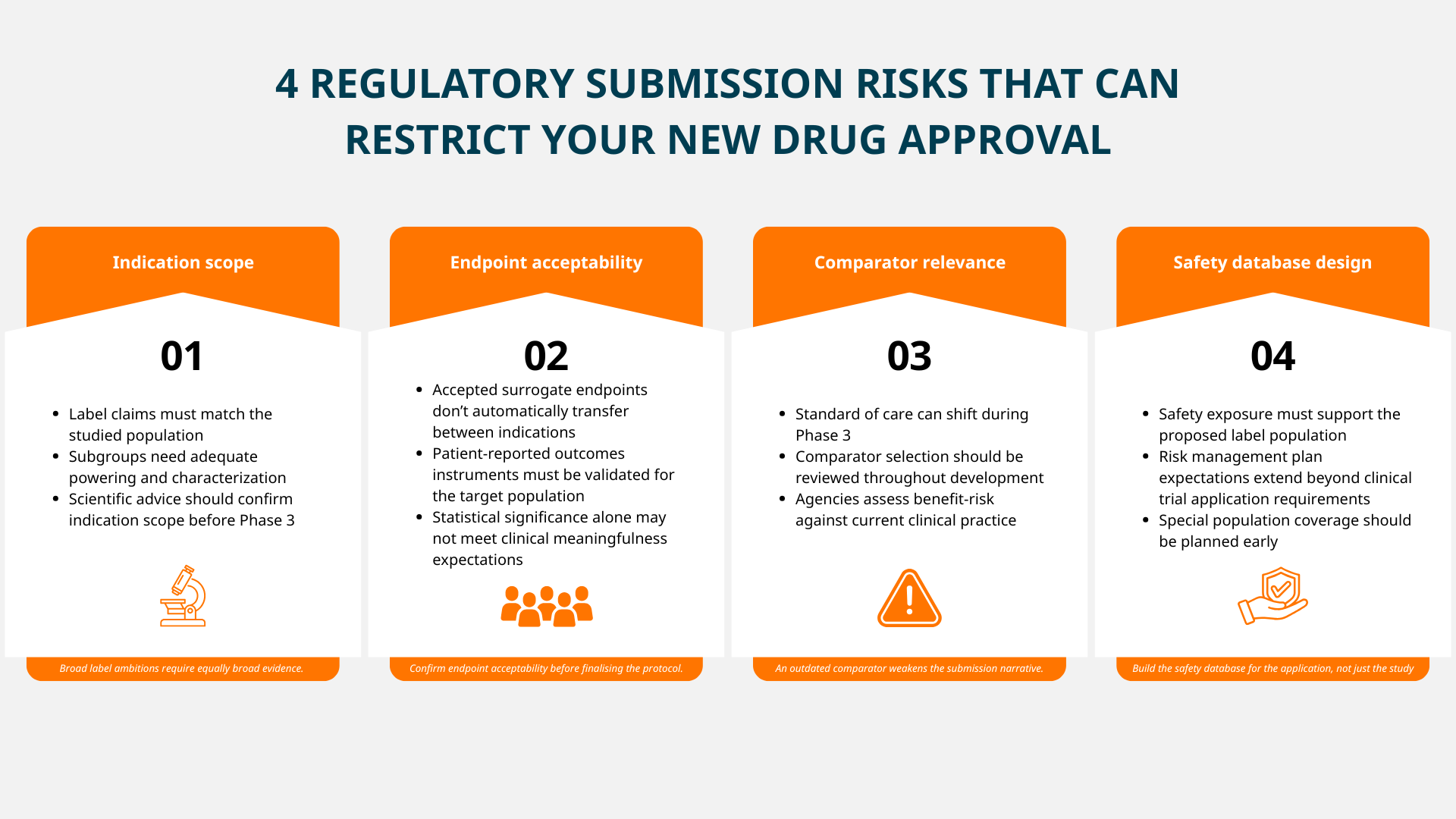
1. Indication scope
The EMA and MHRA assess whether the drug works in the specific patient population described by the proposed label. When a pivotal study was designed around a particular disease subtype or severity stratum, reviewers probe the generalizability of that data against a broader label claim. The outcome is typically a label restriction.
Sponsors who address these pressure points before the pivotal design is finalised go into Phase 3 with a stronger foundation for new drug approvals:
- Population definition. Confirm that the proposed label population and the planned study population are the same. Any divergence between them needs a scientific justification that the agency will accept.
- Subgroup adequacy. If the label will cover subgroups — by age, disease severity, or biomarker status — the pivotal study needs to be powered to characterize those subgroups, or the label will be restricted at review.
- Scientific advice timing. EMA scientific advice and MHRA innovation office engagement exist to test the indication scope before the pivotal protocol is finalized. Sponsors who use these mechanisms go into Phase 3 knowing where the evidentiary line sits.
2. Endpoints
Endpoint selection is where the distance between clinical operations thinking and regulatory strategy tends to be most costly.
The specific failure modes worth knowing include:
- Surrogate endpoint transfer. Acceptance of a surrogate in one indication does not extend to another. The EMA evaluates whether a surrogate has been validated as a reliable predictor of clinical benefit in the disease being studied — and that validation is indication-specific. A surrogate accepted for a related oncology program may face a formal objection in a new regulatory submission for a distinct indication because the biological rationale for that predictive relationship has not been established in this context.
- PRO instrument qualification. A patient-reported outcome (PRO) instrument developed and validated in one rare disease population is not automatically acceptable in another. If the instrument was not developed with the target population or was not qualified through the relevant regulatory process, it will not hold as a primary or key secondary endpoint regardless of how carefully the data were collected during the trial.
- The clinical meaningfulness threshold. The EMA and MHRA set a threshold for clinical meaningfulness that is indication-specific and frequently sits higher than sponsors assume at the point of clinical protocol design. Statistical significance and approvability address different questions, and conflating them at the design stage creates problems that surface at review.
All three of these issues have the same solution: confirm endpoint acceptability with the relevant agency through scientific advice before the pivotal protocol is locked in.
3. Comparators
In indications where the treatment landscape has shifted — due to new drug approvals, updated clinical guidelines, or changes in prescribing practice — a three-to-five year drug development timeline creates real regulatory submission exposure.
Agencies assess benefit-risk against the clinical context at the time of review. When the comparator arm represents a therapy that has since been superseded, the benefit being claimed is measured against a benchmark that no longer describes how patients are actually treated.
The points to address proactively include:
- Late Phase 2 comparator review. Before the pivotal protocol is finalized, formally assess whether the intended comparator still represents the standard of care. If it does, document that assessment. If it does not, the time to address it is before pivotal execution starts.
- Ongoing landscape monitoring. Build a scheduled comparator review into the Phase 3 oversight calendar — particularly in indications where new entrants are expected. A landscape that shifts during Phase 3 is manageable if it is identified early.
- Proactive justification. If the comparator has moved by the time Phase 3 data are maturing, address it directly in the clinical study report and the benefit-risk discussion. Leaving reviewers to draw their own conclusions about comparator relevance is a less favorable position than presenting a prepared, well-reasoned argument.
4. Safety database design
Pharmacovigilance planning during early-phase clinical development tends to be scoped to what a clinical trial application (CTA) requires. Adequate monitoring, signal detection, and expedited reporting keep the program running safely and meet the regulatory minimum.
A marketing authorization application is held to a different standard.
At regulatory submission, the EMA and MHRA want to see:
- Population exposure adequacy. Safety characterized across the proposed label population with sufficient exposure duration to support the claims being made.
- A credible risk management plan. An RMP that reflects a safety profile assembled from adequate data, not one constructed under time pressure from a sparse database at the point of filing.
- Special population coverage. Data covering populations included in the proposed label, such as pediatric patients or those with hepatic or renal impairment, or a clearly justified post-approval plan for generating it. Where a pediatric investigation plan (PIP) is required under EU/UK regulation, that obligation needs to be factored into the drug development timeline from the outset.
Before Phase 2 and Phase 3 study designs are finalized, map the safety section of the intended marketing authorization application. Identify which subgroups require dedicated safety data, what exposure duration the agency will expect, and whether known or anticipated risks will require specific RMP categories.
Build your regulatory submission case before you need it
Although regulatory affairs, clinical operations, and pharmacovigilance often work from the same development timeline, they do so without a shared view of what the submission needs to demonstrate.
You should establish a shared regulatory narrative in early-phase clinical development and review it at each major milestone to catch these problems early.
The sponsors who reach new drug approvals in the EU and UK with the fewest late-stage corrections are the ones who treated early development decisions as submission decisions — applying that discipline to indication, endpoints, comparators, and pharmacovigilance from the first stages of the clinical development plan.
TMC Consulting provides integrated pharma consulting services spanning regulatory affairs, clinical development strategy, pharmacovigilance, and medical services. Our specialists work with small to mid-sized US sponsors to align early-phase clinical development decisions with EU and UK regulatory expectations — identifying where the evidence package needs strengthening while there is still time to act.
To discuss where your program stands and see how we can help you build toward marketing authorization from the earliest stages of your drug development process, speak to our team today at connect@tmcpharma.com.