
European marketing authorization can feel like the summit.
Years of clinical development, regulatory navigation, and evidence generation — all aimed at that approval decision. But authorization doesn’t hand you a launch; it hands you a new set of obligations.
Many US biotech and pharma sponsors underestimate or don’t understand what’s required for post-approval in the UK/EU.
Without a functioning EU and UK commercial operation in place at the point of approval — covering compliance, distribution, pharmacovigilance, and medical support — you’re left with a significant gap between authorization and actual market access.
A lean, scalable drug commercialization strategy is essential for sponsors in this position.
Why EU and UK drug commercialization processes are different from what US sponsors expect
Approval in the US doesn’t create an automatic template for Europe.
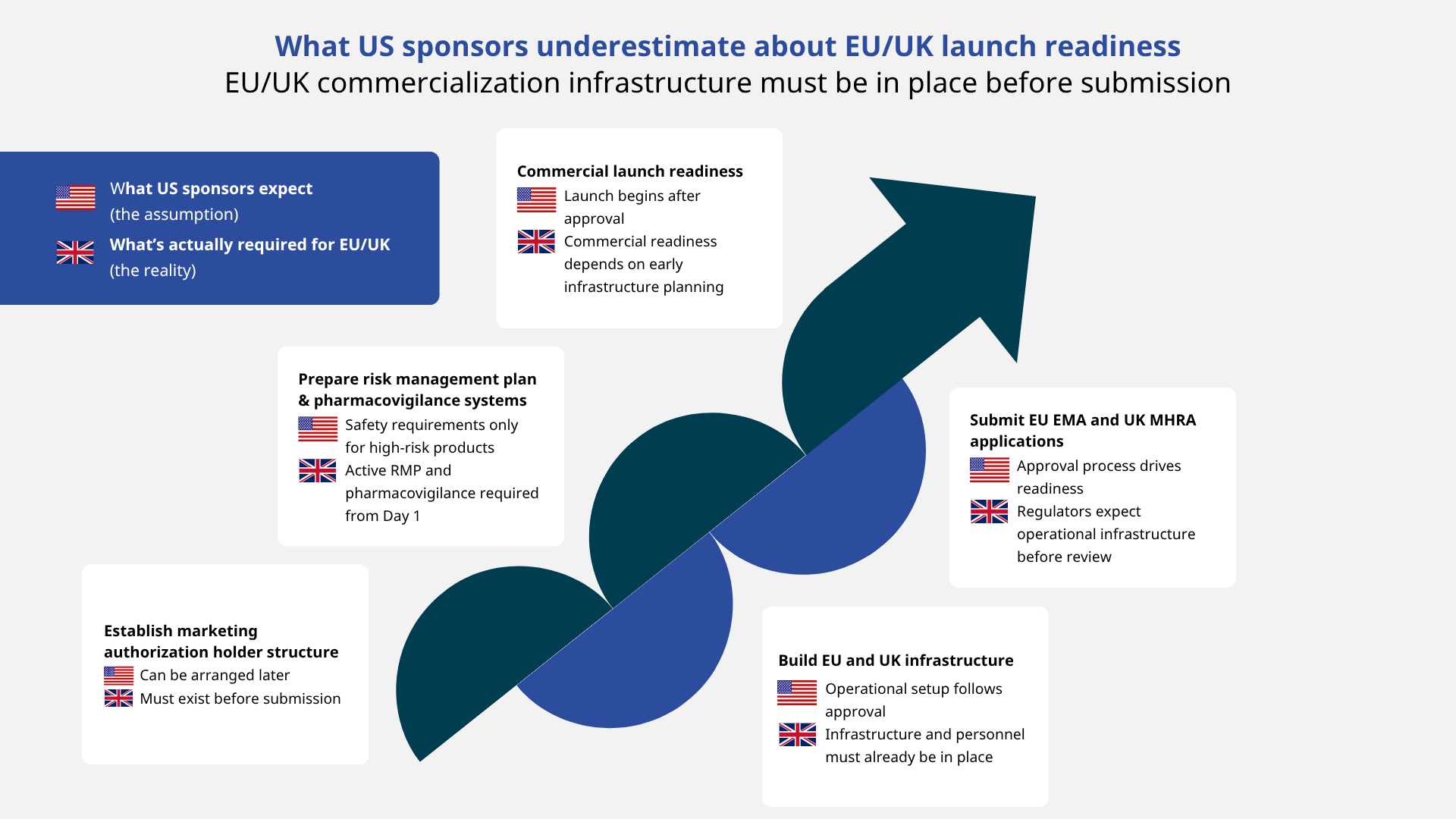
The most immediate difference is the (MAH). In both the EU and UK, the MAH must be a legal entity established in the relevant jurisdiction. A US company without a qualifying subsidiary cannot hold its own marketing authorization, which means you need to have either established a local entity or appointed a third party to hold that authorization on your behalf before you can commercialize your product in Europe.
Post-Brexit, the EU and UK are separate regulatory territories with separate marketing authorization holder requirements. If you’re looking to target both markets, you’ll need a compliant infrastructure in each.
The UK Medicines and Healthcare products Regulatory Agency (MHRA) and the European Medicines Agency (EMA) operate distinct timelines for marketing authorization applications — 150 active days and 210 active days, respectively — and both assume the applicant’s infrastructure is already operational, not in progress.
The EU and UK also require a risk management plan (RMP) for all new marketing authorization applications, as a standing condition of authorization. This differs from the US FDA system, where risk evaluation and mitigation strategies (REMS) are triggered only for products with specific high-risk profiles. From the moment your EU/UK marketing authorization is granted, you carry a live pharmacovigilance obligation that must be maintained and updated throughout the product lifecycle.
The four pillars of a lean EU/UK launch model
Each of the following areas represents a standing operational requirement that needs to be in place at authorization, not assembled in the months after.
1. Marketing authorization holder
EU/UK marketing authorization holder requirements mean the MAH carries legal accountability for the product from authorization onward — pharmacovigilance, quality, labeling, good manufacturing practice (GMP) oversight, and engagement with regulatory authorities across the product lifecycle. If you don’t have a qualifying EU or UK entity, an experienced external MAH removes the need to establish a local subsidiary before launch.
The distinction most sponsors miss is that an external MAH acts on behalf of the sponsor, not as a licensee. The sponsor retains strategic ownership. The MAH manages the compliance burden.
Getting this relationship structured correctly — with clear contractual and technical agreements — is what makes the partner model workable without trading control for convenience.
Post-approval regulatory affairs obligations — including label variations, periodic safety update reports (PSURs), RMP updates, and authority queries — flow directly from the marketing authorization, and the MAH is responsible for keeping pace with them. The setup work happens before authorization.
2. Pharmacovigilance
EU and UK pharmacovigilance (PV) obligations can begin before authorization. If your product is already marketed in another region, submitting a marketing authorization application triggers the requirement to collect and report safety cases to EU and UK authorities — meaning PV infrastructure may need to be in place ahead of approval, not when the first safety signal appears.
Sponsors need a qualified person for pharmacovigilance (QPPV) appointed, a pharmacovigilance system master file (PSMF) in place, and functioning processes for adverse event collection, signal detection, and regulatory reporting — all operational before or at the point of submission if the product is already authorized elsewhere.
Building this reactively, after authorization, is where compliance gaps appear. The PSMF alone requires documented processes, trained personnel, and an audit-ready system — none of which come together overnight. Integrating PV planning into the MAH appointment and pre-authorization timeline, rather than treating it as a separate workstream, is what keeps the launch compliant and the timeline intact.
3. Pharma distribution
You need qualified pharma distribution partners with documented chain-of-custody processes, import and batch release arrangements, and — for temperature-sensitive products — validated cold-chain management. Each country-level distribution pathway adds regulatory and logistical complexity that needs to be mapped before the product reaches the market.
An often-overlooked requirement is the wholesale dealer’s license (WDL) — you will need a separate WDL for the UK and for the EU. Without these licenses, your company cannot legally sell its own product in either market. Obtaining a WDL can take up to a year, so this needs to be factored into your planning timeline well before launch.
If you have no existing European logistics infrastructure, this isn’t something to build from scratch under time pressure. The partner you choose needs good distribution practise (GDP) certification, audit oversight capability, and the operational experience to manage multi-country distribution without creating supply reliability risk at launch.
4. Medical affairs
A medical affairs contact person must be named in your marketing authorization application form; this function needs to be in place before submission, not just post-authorization. While the named contact can be updated later, it’s one more requirement that has to be resolved as part of submission preparation. If your product is already marketed outside the EU or UK, you ideally want the same medical affairs team managing those existing markets to also cover EU and UK. Consistency across regions reduces risk and avoids duplication of effort.
Post-authorization, a medical affairs function also supports scientific exchange with clinicians, publication activity, and interactions with health technology assessment (HTA) bodies — the national agencies that determine reimbursement access in individual EU member states.
It doesn’t require a large in-house team. A specialist partner can provide proportionate medical affairs support that scales with your product’s launch stage and market footprint — giving you the clinical and commercial credibility you need without a fixed headcount commitment that outpaces early revenue.
The operating model question: build, out-license, or partner?
Three options are realistically available to a US sponsor without existing EU or UK infrastructure.
- In-house. Building in-house means establishing a legal entity, recruiting EU and UK regulatory and quality staff, standing up pharmacovigilance systems, and contracting compliant distribution — all before or at the point of authorization. For a company entering a first European market, this is capital-intensive and slow. It also generates operational complexity at the moment when development costs have already peaked.
- Out-licensing. A European licensee already has the infrastructure. But the trade is significant: the licensee’s interests govern how the product is priced, positioned, and sold. Sponsors who out-license in haste often spend years trying to renegotiate terms or watch a product they spent a decade developing perform below its potential because the commercial strategy wasn’t theirs to shape.
- Scalable partner model. A specialist pharma services company holds the MAH, runs pharmacovigilance, manages pharma distribution, and provides medical affairs support — while the sponsor retains full ownership of the asset and controls strategic direction. The partner provides the EU/UK operational presence; the sponsor decides how the product is positioned, priced, and developed commercially. This is the model that makes a lean EU pharma strategy viable for companies that don’t yet have European headcount.
The instinct for many small sponsors is to out-license to a local European partner to move quickly. But that option typically means surrendering control of your asset and commercial positioning.
Launch and scale across the EU and UK without losing control of your asset
For emerging US sponsors, the real risk in European drug commercialization isn’t taking on too much infrastructure. It’s making a rushed decision — out-licensing to the first viable European partner, or deferring the operational setup until authorization is imminent — that costs control of the asset before it has a chance to perform.
A partner-led model doesn’t mean handing the product over. It means having a pharma services company hold the MAH and run operations on your behalf, while you retain pricing, positioning, and strategic direction.
TMC Commercial provides flexible drug commercialization services for late-stage and commercial-ready biotech and pharma companies entering the EU and UK markets.
As an established EU/EEA-based MAH, TMC can act as your marketing authorization holder, QPPV, and EU/UK regulatory representative — covering the full compliance infrastructure your product requires at launch.
TMC’s drug commercialization solutions also span pharma distribution, medical affairs, and post-approval regulatory affairs support, giving you a single operational partner for European market entry. Beyond launch, TMC can take responsibility for lifecycle maintenance compliance — including routine regulatory submissions and variations required when anything in the product’s dossier needs to change — ensuring your product remains compliant throughout its authorized lifetime.
To find out how TMC’s drug commercialization services can support your EU and UK launch without requiring you to out-license or overextend your internal team, contact us at connect@tmcpharma.com.