
More than 90% of oncology protocols implement at least one amendment, with an average of four per protocol, significantly higher than in non-oncology trials.
That figure, drawn from a study analyzing nearly 1,000 clinical study protocols, reflects something most sponsors in complex oncology already know from experience: the protocol almost never survives first contact with operational reality unchanged. Implementing a single amendment takes an average of 260 days from initiation to final approval. During that window, sites can be operating under different protocol versions simultaneously.
Some amendments are unavoidable, as new safety data emerges or regulators ask questions. But research suggests that approximately 23% of amendments could be prevented through better initial clinical protocol design and planning.
This blog focuses on that 23%, including the upstream decisions in your clinical development plan that prevent avoidable disruption, and why decentralised clinical trials fit into that thinking for this patient population.
Why complex oncology clinical trials attract more amendments
The reason amendment rates in oncology are structurally higher than in most other therapeutic areas runs deeper than trial complexity, reflecting specific characteristics of how oncology trials are designed and the patients they enroll.
The most common drivers :
- Heterogeneous patient populations. Tumor genetics, prior treatment lines, and comorbidities vary widely across oncology patients. Eligibility criteria written before feasibility is fully interrogated are frequently too narrow to enroll efficiently, or too broad to generate interpretable data — both of which create pressure to amend.
- Standard of care that evolves mid-trial. Background therapy assumptions and concomitant medication restrictions written at protocol lock can become clinically outdated within 12–18 months, particularly in indications where treatment practice is moving quickly.
- Adverse event profiles are difficult to predict precisely. The nature of safety events in oncology is expected, but their specific nature often isn’t. Dose modification rules and stopping criteria written without deep indication-specific input frequently require retrospective adjustment once real patient data starts coming in.
- Visit schedules that sites cannot deliver, or patients cannot cope with. Assessment windows and visit frequencies that appear rational in a protocol document often prove unrealistic once sites are managing actual oncology patients — people whose capacity for frequent, intensive visits is constrained by their treatment and its side effects.
Where avoidable clinical protocol design amendments originate
When protocol design is driven by submission timelines rather than operational readiness, the systematic work of stress-testing the protocol against reality doesn’t happen.
Walking through case scenarios — how the protocol would actually be conducted at site, by the patient, visit by visit — surfaces friction points, feasibility gaps, and ambiguous language before they become problems. Without that review, protocol language gets reinterpreted in the field to accommodate operational reality, and amendments follow.
Decisions that shape the clinical protocol design must, therefore, be made with sufficient scientific, medical, operational, clinical, and safety input to mitigate avoidable amendments.
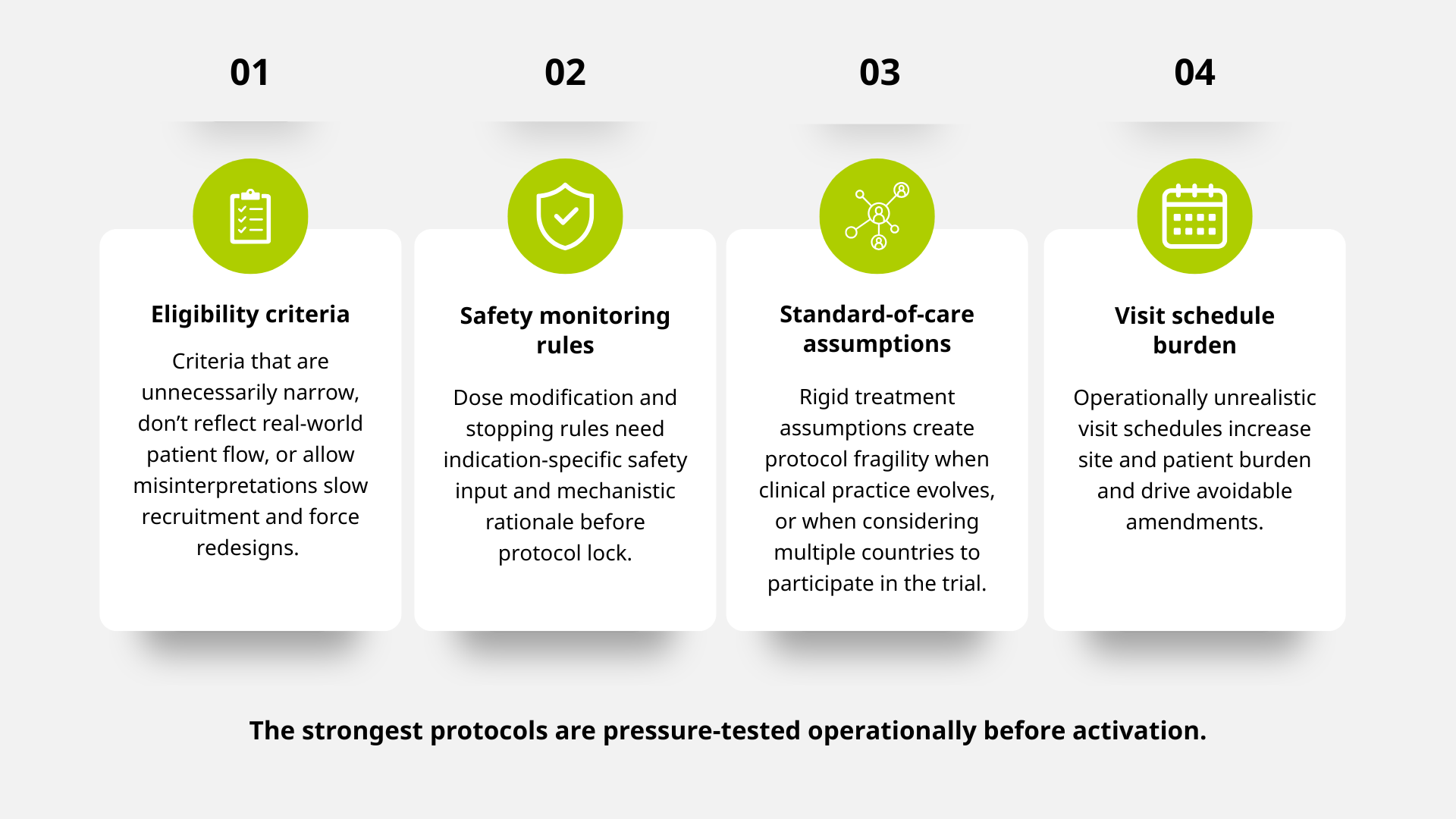
1. Eligibility criteria that don’t survive site-level reality
Inclusion and exclusion criteria are the most common source of avoidable amendments in oncology clinical trials. Criteria built from the literature rather than real-world patient flow tend to be overly restrictive, which slows screening rates, or insufficiently specific, which introduces heterogeneity into small sample sizes. Both force design changes post-activation.
Pressure-testing eligibility against natural history data, patient registries, and site-level feasibility input before protocol lock is what reduces this risk.
2. Safety monitoring rules written without indication-specific input
Dose modification guidelines and stopping rules need to reflect the known safety profile of the tumor type, the line of therapy, and the mechanism of action under study, as well as the regulatory expectations for how decision-making rationale is documented and justified.
When pharmacovigilance and safety expertise are brought in as a late review rather than embedded in protocol development, rules often don’t hold up against what sites actually see. Cross-functional safety input at the clinical trial study design stage closes this gap before the trial opens.
3. Concomitant medication and standard-of-care assumptions
Hard restrictions against a fixed snapshot of treatment practice create fragility. In active oncology indications, the standard of care can shift meaningfully within the span of a single trial.
Rather than writing rigid rules, building structured review mechanisms or managed deviation pathways into the protocol gives it resilience over its lifespan — so that when practice evolves, the protocol doesn’t immediately require formal amendment to remain clinically appropriate.
4. Unrealistic visit schedules that create significant site or patient burden
A visit schedule that looks deliverable in a protocol document can fail operationally when it meets real oncology patients managing active treatment toxicity, complex comorbidities, and long travel times to specialist centers.
Bringing in site staff and patient input during clinical protocol writing — combined with a thorough time-and-motion study of each visit mapping both the site and patient journey — surfaces the friction points early, when they can be resolved by design rather than by amendment.
There is a less visible failure mode that runs across all four of these areas.
Even when the right subject-matter experts are involved in protocol development, each typically reviews their own section in isolation, evaluating the technical soundness of their domain without a full view of how their decisions will interact with the rest of the protocol during actual study conduct.
Bridging those gaps requires someone to build case scenarios that cut across every section, walking each expert through the operational consequences of their own inputs, and surfacing the conflicts before they become amendments.
Implementing decentralised clinical trials for rare oncology diseases
The same operational blind spots that affect eligibility, safety rules, and visit scheduling apply equally to decentralised clinical trial integration.
Decentralised clinical trials are increasingly part of clinical development plan discussions across oncology, and for good reason. Oncology patients often receive care at major cancer centers far from where they live, manage significant treatment-related toxicity, and have limited tolerance for site visits that add burden without clinical necessity.
For rare oncology diseases specifically, where patient populations are geographically dispersed and clinical study protocols must work around highly variable, irregular patient journeys, some degree of decentralisation is frequently operationally necessary to achieve meaningful enrollment and retention.
Remote collection of patient-reported outcomes (PROs), telemedicine for symptom monitoring between treatment cycles, and home nursing for certain routine assessments can reduce dropout risk and extend access to patients who would otherwise be screened out on geography alone.
The goal is not to replace the site relationship but to make the bridge between patient and site smoother, using decentralised elements to reduce burden at the points where in-person attendance adds no medical or scientific value. Identifying those points requires discipline. The question to ask during clinical protocol design is which assessments truly require a patient’s physical presence at the site and which don’t.
However, decentralised clinical trials in rare oncology diseases do come with constraints:
- Adverse event monitoring may need in-person examination and lab assessment — remote substitution risks missing safety signals, with direct consequences for pharmacovigilance integrity.
- Imaging and tumor response assessments must be performed at calibrated sites using standardized protocols.
- Tissue, blood, and pharmacokinetic (PK) sample integrity depends on site infrastructure — home-based collection introduces chain-of-custody risks.
- Regulatory acceptance of decentralised clinical trials varies by country — what is permitted in the US or EU may not be permitted elsewhere, and scientific advice can take two to three months per country. Protocols that don’t account for this at the design stage may face costly amendments later.
Design clinical study protocols for the full trial, not just the start
Amendment avoidance in complex oncology is a design discipline. The decisions that protect timelines — in eligibility, safety monitoring, visit structure, and decentralised clinical trial integration — are made before the protocol is locked.
Not every amendment is avoidable, and sponsors should build governance structures that can triage and progress them efficiently when needed. Pre-agreed escalation pathways and established regulatory relationships mean that necessary amendments move faster and cause less disruption.
But the foundation is the clinical protocol design itself — and the clinical development plan decisions that shaped it.
TMC Clinical specialises in early-phase clinical development for rare diseases, including rare oncology diseases.
As a global pharma services company combining the capabilities of a clinical research organisation with focused therapeutic expertise, TMC Clinical provides cross-functional support across clinical protocol design and writing, site feasibility, safety, and pharmacovigilance planning.
Our clinical operations experts work across subject-matter boundaries — building the case scenarios that challenge each domain and surface the operational consequences of protocol decisions before lock, not after activation. This cross-functional approach helps you build clinical study protocols that hold up across the full lifecycle of the trial, including the integration of decentralised clinical trial elements.
Every avoidable amendment costs an average of 260 days. Speak to the TMC Clinical team today at connect@tmcpharma.com to get your protocol design right from the outset.