
In the EU and UK, a risk management plan (RMP) is a mandatory requirement for all marketing authorization applications, which becomes an ongoing commitment the marketing authorization holder (MAH) must maintain throughout the product lifecycle.
This is a meaningful difference from the US system, where risk evaluation and mitigation strategies (REMS) are only required for products with specific high-risk profiles. Once authorized in the EU or UK, every product’s pharmacovigilance (PV) obligations are supported by the details maintained and updated within the RMP.
From the date of authorization, the document you submitted to support approval becomes a living commitment that has to keep pace with new safety data, label changes, and the day-to-day reality of the PV system behind it.
That need to update a RMP is initiated following specific types of PV triggers. A new or evolving safety signal (identified in a periodic safety update report (PSUR) or via signal management activities), a labeling change, or a regulatory request can each independently require the document to be revised, sometimes outside your planned review cycle.
This blog works through what changes in an RMP after approval, who’s accountable for keeping it current, and where post-approval regulatory affairs commitments typically start to drift.
What changes in a risk management plan after approval
Three areas account for most post-approval RMP activity: updates to the safety specification itself, the variations those updates can trigger, and the ongoing alignment with the PV system that supports implementation and effectiveness checks of the plan.
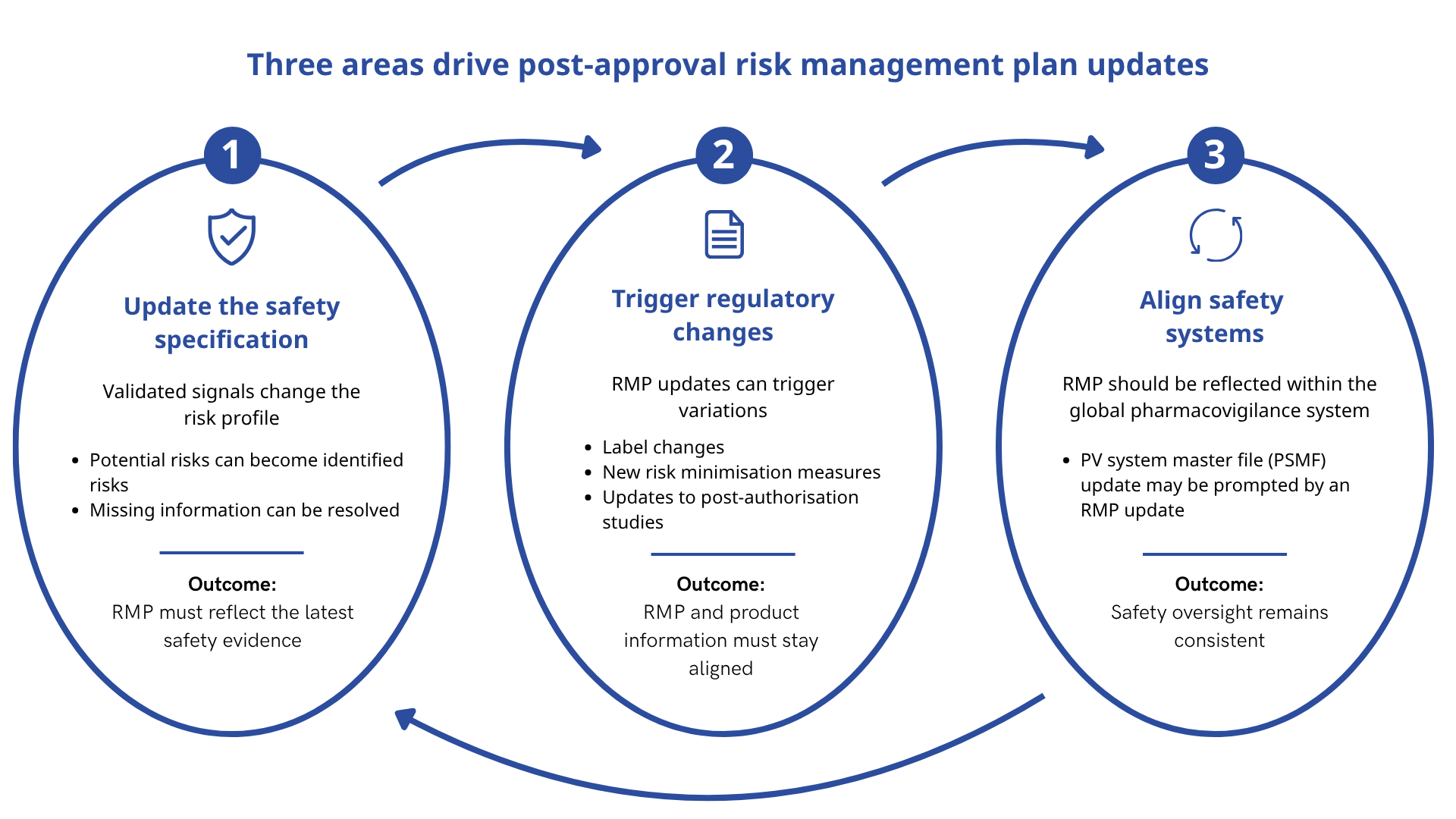
1. Safety specification updates triggered by signal follow-up
The safety specification is the part of the RMP most directly shaped by ongoing PV activity. As signals are evaluated, the conclusions feed directly into how a safety concern is classified:
- An important potential risk gets reclassified as identified. Accumulating case evidence or a completed study can convert a theoretical concern into a confirmed one, which usually changes the risk minimization measures attached to it.
- A new safety concern is added. A signal that wasn’t anticipated at approval, often surfaced through routine case review or a periodic safety update report, needs its own entry and evaluation plan.
- Missing information gets resolved or replaced. Gaps identified at approval, such as limited long-term data, get closed as more evidence accumulates, or replaced with a new gap if the resolution reveals something unexpected.
Each of these reclassifications depends on PV performing a formal review of the signal evaluation output and making an informed decisions as to whether or not the RMP still reflects it accurately.
2. Variations triggered by RMP and labeling changes
Not every RMP update can be filed as a standalone safety submission. Several types of change require a formal variation to the marketing authorization itself:
- Label changes flowing from a reclassified risk. If a safety concern moves from potential to identified, the product information often needs updating to reflect it, which means a variation alongside the RMP revision.
- New risk minimization measures. Adding a patient guide, a healthcare professional communication, or a controlled access program isn’t just a PV decision; it usually requires regulatory approval through a variation.
- Changes to the additional PV activities themselves. Adding, removing, or modifying a post-authorization PV activity, such as a post-authorization safety study (PASS) changes the commitments described in the marketing authorization and typically needs to be submitted as a variation.
The timing matters as much as the content. An update that’s ready before the corresponding variation is submitted creates a window where the RMP and the authorized product information don’t match.
3. Keeping the RMP aligned with the pharmacovigilance system master file
The pharmacovigilance system master file (PSMF) describes how your safety system operates: who does what, which processes are in place, and how signals are detected, evaluated, and escalated. The RMP describes the product-specific commitments built on top of that system.
These two documents need to align, so avoid having different people update them on different schedules. This pitfall is often how discrepancies occur. For example, the PSMF might describe a signal detection process that’s since been outsourced to a new vendor, while the RMP still references the old arrangement.
The qualified person for pharmacovigilance (QPPV) is generally accountable for flagging these inconsistencies, since they oversee both documents and the broader safety system behind them. In practice, that oversight only works if there’s a defined point in the update cycle where the two documents are checked against each other, rather than each being revised in isolation.
Where pharmacovigilance hands off to post-approval regulatory affairs
Traditionally, although the PV team may own the monitoring, evaluation, and compilation of safety documents (including updates), their finalisation and submissions are usually owned by regulatory affairs. The marketing authorization holder carries legal accountability for all of it, which means compliance exposure sits with whoever holds that authorization.
Having a defined handoff point — where a safety conclusion, an RMP change, and a variation submission are reviewed together before any are finalized — is essential to ensure post-approval regulatory affairs activity moves as one coordinated process.
To ensure alignment after approval, run this check on your risk management plan at each scheduled review, and whenever a signal evaluation concludes:
- Confirm the safety specification matches the latest signal conclusions. Check that every reclassified risk and resolved data gap is reflected in the current version, not just noted in a meeting record.
- Map every RMP change to its corresponding variation. Identify whether the update can stand alone or needs a formal submission, and confirm the timing of each.
- Cross-check against the pharmacovigilance system master file. Make sure the processes the RMP assumes are in place match what the master file describes.
- Verify periodic safety update report conclusions were carried forward. Confirm that any safety concern raised in the latest report has a documented disposition in the plan.
- Name a single owner for the update cycle. One person or function should be accountable for confirming alignment across the RMP, the variation, and the PSMF.
- Check the MAH’s record matches reality. Confirm that whoever holds legal accountability has visibility into the current status of all three records.
- Set a recurring date to reconcile all three documents, independent of any single trigger.
Give your risk management plan a single, accountable owner
For a risk management plan to remain accurate after approval, someone must be accountable for checking that the safety specification, the variations, and the PSMF all still describe the same product.
TMC Commercial can act as your marketing authorization holder, taking on the legal accountability for keeping your RMP, PSUR submissions, and variations aligned throughout your product’s authorized lifetime.
If your product has been through one or two update cycles since approval and you want a second look at whether your risk management plan, pharmacovigilance system master file, and post-approval regulatory affairs activity still align, speak to our team today.