
The European Medicines Agency (EMA) review clock starts from the day a valid marketing authorization application is received. From that point, the standard timeframe for a centralized procedure review is 210 active days.
“Active” is the operative word. Clock stops for questions, missing data, or quality issues can extend real-world timelines well beyond that.
Operating through its own national routes, the UK Medicines and Healthcare products Regulatory Agency (MHRA) offers faster timelines, such as its 150-day timeline, for a high-quality dossier. Clock stops still apply, though.
The 12–18 months before regulatory submission is where timeline confidence is built or lost. This guide walks through the workstreams that US sponsors — particularly those without established EU/UK infrastructure — need to lock down during that window, and what happens when they don’t.
Why the EU/UK process catches US sponsors off guard
If your regulatory experience is grounded in the US Food and Drug Administration (FDA) system, several aspects of the EMA and MHRA processes will feel unfamiliar.
The table below highlights some of the key structural differences. Each area represents a workstream that needs to be scoped and resourced before submission, not identified during review.
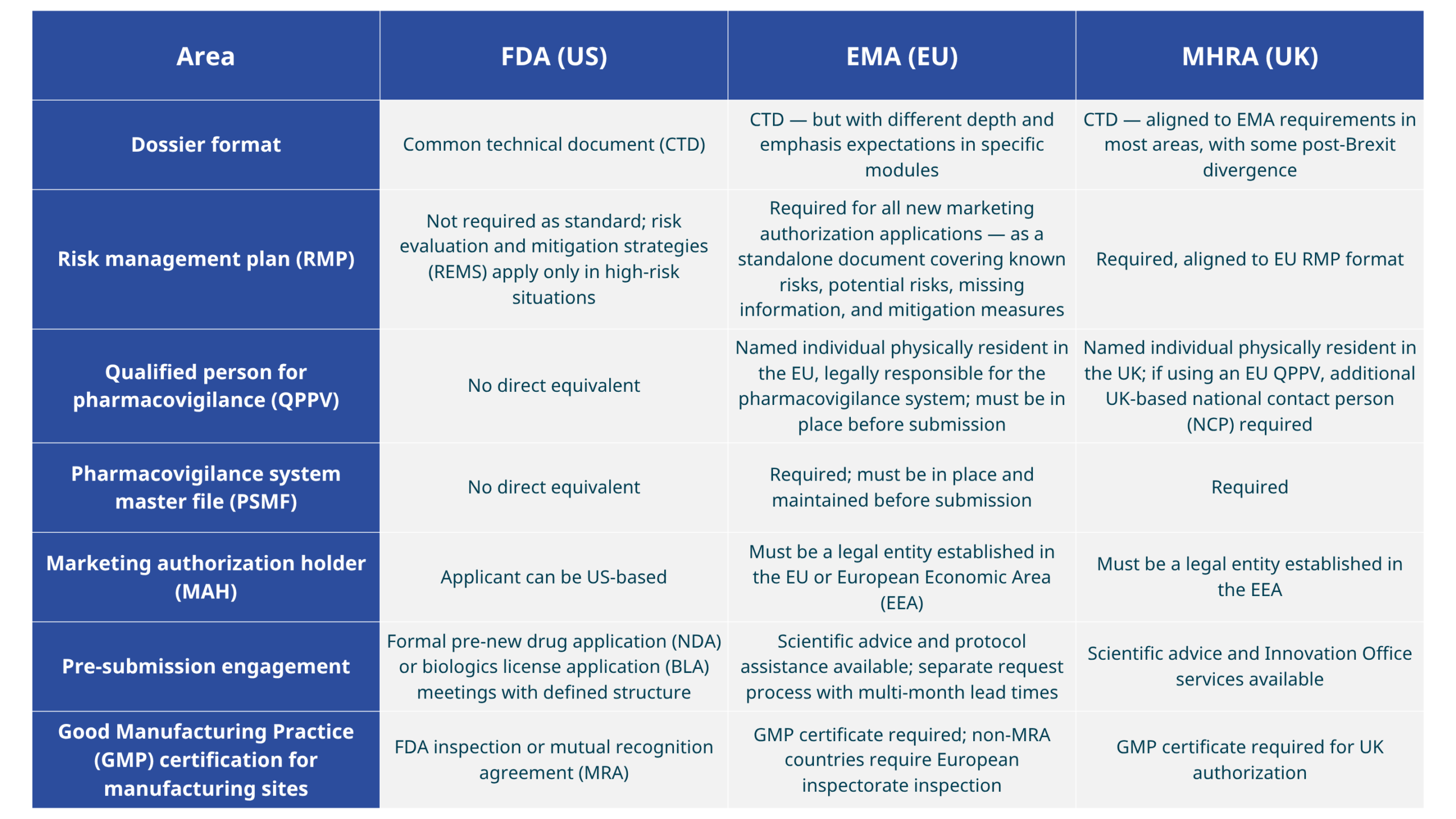
For a US company without EU or UK infrastructure, several of these items — QPPV appointment, MAH setup, PSMF development — are months-long workstreams in their own right. Starting them at the 12-month mark is realistic. Starting them at six months is not.
Module readiness: closing documentation gaps before they block regulatory submission
Module 3 (quality, chemistry, manufacturing, and controls) and Module 5 (clinical study reports) are where most submission delays originate. The documentation often doesn’t yet meet EU/UK standards, even when the underlying data does.
Module 3 requirements that frequently catch US sponsors short include:
- Commercial manufacturing process validation documentation at the level EU/UK regulators expect.
- Stability data covering the intended EU shelf life, which may differ from what was generated for FDA purposes.
- Container closure system validation.
- Current GMP certification from an EU or UK authority, or equivalent recognition under an MRA, for every manufacturing site — including API manufacturers and contract packagers.
- Full GMP compliance documentation for each site in the dossier.
Another frequently overlooked area is the pediatric investigation plan (PIP). Unlike in the US, where a pediatric study plan (PSP) is not required for an orphan product, an approved PIP — or a waiver — must be in place before submitting a marketing authorization application to the EMA or MHRA.
Module 5 requirements that commonly create problems include:
- All pivotal study reports must be finalized, signed off, and supported by complete datasets before submission.
- EU regulators assess whether clinical data support the proposed indication and benefit-risk profile for the EU/UK patient population specifically.
- Trials designed primarily for FDA approval — with US-specific comparators or endpoints that don’t reflect the European standard of care — can generate Day 120 questions that are difficult to answer with the existing data package.
Twelve months before regulatory submission is the point to complete a thorough gap analysis across both modules, not six months before, when remediation options narrow significantly.
Pharmacovigilance and safety readiness
This is the area where US sponsors most consistently underestimate lead time requirements. Beyond appointing the QPPV and drafting the PSMF, you need a functioning pharmacovigilance system (one that is capable of collecting, processing, and reporting adverse events from day one of authorization) in place before the application is filed.
The RMP requires a structured characterization of the product’s known and potential risks, missing information, and the pharmacovigilance and risk minimization measures that will address each one.
Unlike FDA risk evaluation and mitigation strategies (REMS), which are triggered by specific high-risk situations, the EU RMP is required for all new marketing authorization applications. It becomes a living document that must be updated throughout the product lifecycle and aligned with any label changes.
If post-approval regulatory affairs obligations feel distant at this stage, they shouldn’t. The way your pharmacovigilance infrastructure and RMP are set up at submission shapes the compliance burden — and the risk — you carry after authorization.
Partner inputs and contracted services
For US sponsors entering EU/UK markets without established local infrastructure, the question of who holds the marketing authorization matters as much as what’s in the dossier. An EU or UK marketing authorization holder (MAH) must be a legal entity established in the EU or the UK, respectively.
If your US company doesn’t have a qualifying subsidiary, you’ll need to appoint a marketing authorization holder — and that relationship needs to be structured, documented, and operational before submission.
The MAH takes on significant legal accountability, including compliance with the terms of the authorization, pharmacovigilance, GMP oversight, drug labeling, and more. Selecting the right MAH and establishing the contractual and technical agreements that govern the relationship is not a quick process. Starting these conversations 12–18 months before submission gives you time to evaluate options carefully rather than making a pressured decision close to filing.
The same logic applies to EU/UK-based regulatory affairs support, local qualified persons (QPs) for batch release, and any distribution or logistics partners that need to be in place by the time authorization is granted. Drug commercialization services that span regulatory, quality, and commercial functions are worth evaluating early because the setup work required cuts across all of them simultaneously.
Health authority interaction planning
Pre-submission meetings with the EMA and MHRA are not equivalent to FDA pre-NDA/BLA meetings in structure, but they are available and underused by US sponsors.
The EMA offers several formal mechanisms for pre-submission interaction. Scientific advice allows sponsors to seek guidance on clinical, quality, or non-clinical questions — ideally well before the pivotal study starts, when the advice can still meaningfully shape the development program. For products with orphan drug designation, protocol assistance is the equivalent procedure. These procedures require structured briefing documents and take several months from request to outcome.
If you are approaching the 12-month mark before submission, the relevant mechanism at that stage is a formal pre-submission meeting request, which is a separate procedure from scientific advice.
Sponsors with innovative products targeting unmet medical needs should also be aware of the EMA’s PRIME (PRIority MEdicines) scheme. PRIME is designed to support early development of medicines that offer a major therapeutic advantage over existing treatments or benefit patients with no treatment options.
The MHRA offers equivalent pathways for products seeking UK authorization. The standard scientific advice pathway follows a similar structure to the EMA procedure. The Innovation Passport, part of the Innovative Licensing and Access Pathway (ILAP), is specifically designed to support early development of innovative products targeting unmet needs — essentially, the UK’s counterpart to PRIME.
Both routes can clarify regulatory expectations for the UK market, which — post-Brexit — has diverged from the EU in some areas, particularly for accelerated pathways and certain product types.
Early engagement surfaces questions and expectations that can shape how you finalize the dossier, the label, and the post-approval commitments you’re willing to accept. Sponsors who skip this step often spend their Day-120 clock stop responding to questions that earlier dialogue would have preempted.
Quality systems and audit readiness
GMP compliance for EU/UK purposes is enforced by the relevant authority in the country where manufacturing takes place, or by the EMA/MHRA for sites outside the EEA/UK. Each manufacturing site — including API manufacturers, contract manufacturers, and packaging sites — must hold a current GMP certificate recognized under the applicable regulatory framework. Sites in countries without an MRA with the EU or UK require inspection by a European inspectorate, which can take 12 months or more to schedule and complete.
Quality management system (QMS) documentation — standard operating procedures, batch records, validation protocols, deviation management, change control — must be aligned to EU GMP annex requirements and current ICH guidelines. This differs from FDA expectations in several specific areas, including Annex 1 for sterile products, which was substantially revised in 2022, and Annex 11 for computerized systems.
A pre-submission audit of all key manufacturing partners against EU/UK GMP standards, conducted 12–18 months ahead of the regulatory submission, gives time to address gaps before they become submission blockers.
Joint Clinical Assessment: a new layer for EU submissions
For sponsors targeting EU market access, the Joint Clinical Assessment (JCA) process — introduced under EU Regulation 2021/2282 and operational since January 2025 for oncology and advanced therapy medicinal products (ATMPs) — adds a parallel track to be aware of. The JCA will be expanded to orphan medicines in January 2028 and then to all centrally authorised medicines from 2030.
The JCA is a coordinated clinical effectiveness assessment conducted by member state health technology assessment (HTA) bodies, running alongside the EMA review. It does not determine pricing or reimbursement, but it generates a joint clinical assessment report that individual member states then use to inform national HTA decisions.
The JCA dossier is separate from the marketing authorization application dossier and requires its own preparation, including a systematic review of comparative clinical data. Sponsors need to understand what the JCA will require from their evidence package — particularly around comparators and relative effectiveness outcomes — well before submission, because retrofitting the evidence strategy at the dossier stage is expensive and often not possible.
Submit your marketing authorization application with confidence
A marketing authorization application that holds up through a review without significant clock stops, generates a workable label, and leaves you with a manageable set of post-approval regulatory affairs obligations doesn’t come together in the final months before filing. The 12–18 months before submission is where that outcome is determined.
TMC Commercial provides flexible, comprehensive UK and EU drug commercialization services for late-stage and commercial-ready biotech and pharma companies — from pre-submission planning to post-authorization lifecycle management.
As an established EU/EEA-based MAH with SME status, TMC can act as your marketing authorization holder, QPPV, and EU/UK regulatory representative, reducing the operational and compliance burden of EU/UK market entry. TMC’s specialist team helps US sponsors navigate the differences between FDA and EMA/MHRA expectations, structure the critical pre-submission workstreams, and build a dossier positioned for a clean review.
If you’re 12–18 months out from regulatory submission and want to pressure-test your readiness, reach out to the team at connect@tmcpharma.com to learn more about our drug commercialization services.